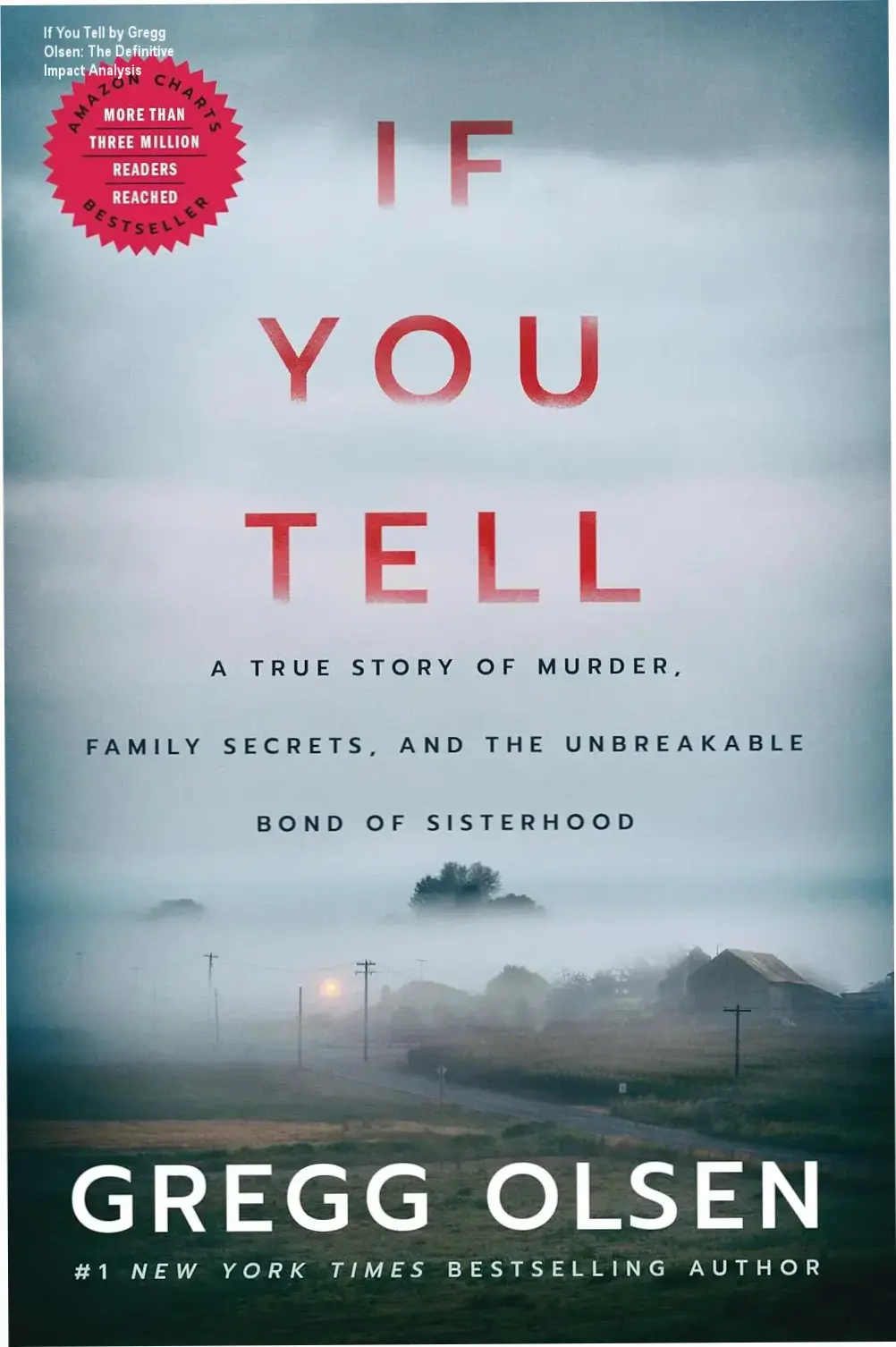
We are conditioned to view the home as a sanctuary. The biological bond between a mother and her children is traditionally framed as the ultimate safety net, a primal source of protection and unconditional love. But what happens when the architect of that sanctuary is actually the predator? When the person tasked with your survival becomes the primary threat to it?
True crime often dances on the edge of voyeurism, but “If You Tell” by Gregg Olsen pushes deeper into the psychological wreckage of systemic domestic torture. For many readers, the expectation is a standard “whodunit” or a clinical autopsy of a crime. Instead, they find a harrowing study of resilience. You can check the current reader reception and availability to see why this narrative has resonated so violently with millions of people worldwide.
This isn’t just a story about murder; it is a dissection of the “house of horrors” phenomenon. It explores how children develop secret languages and unbreakable alliances to survive an environment where the rules change on a whim and the punishment is sadistic. It challenges the reader to question how such extreme abuse can go unnoticed by the outside world for so long.
Ready to dive into “If You Tell”?
Explore available editions, check current live pricing, or download a free sample directly on Amazon.
*You will be redirected to Amazon. As an Amazon Associate, we may earn from qualifying purchases.
The Narrative Engine: Pacing and Visceral Writing
Gregg Olsen doesn’t write like a detached journalist. He writes with a cinematic intensity that makes the reading experience feel claustrophobic. The pacing is deliberate, mirroring the escalating tension within the Knotek household.
He avoids the common true crime pitfall of over-explaining the legal proceedings too early. Instead, he immerses the reader in the psychic terror of the victims first. This creates a powerful emotional hook; you aren’t just reading a case file, you are experiencing the sisters’ entrapment.
The prose is stripped of unnecessary fluff. Olsen uses short, punching sentences that emphasize the shock of the abuse. It is a high-gain information style that keeps the reader moving, even when the subject matter becomes nearly unbearable.
“Sisters forever, victims no more.” This isn’t just a tagline; it’s the emotional spine of the book. The narrative shifts from a story of victimization to one of strategic survival.
The Anatomy of a Monster: Shelly Knotek
Most true crime books try to “humanize” the killer or find a psychological root for their actions. Olsen takes a more skeptical, direct approach. Shelly Knotek isn’t presented as a misunderstood soul or a product of her own trauma.
She is portrayed as a sadistic architect of pain. The book explores the terrifying concept of “psychic terrors”—the way an abuser doesn’t just hurt the body, but dismantles the victim’s sense of reality. This gaslighting is described with clinical precision.
The horror stems from the contrast. On the outside, a farmhouse in Raymond, Washington. On the inside, a torture chamber. This duality is where the book finds its most disturbing power, forcing the reader to realize that evil often wears a mundane mask.
The Bond of Sisterhood: A Survival Mechanism
The core of this book isn’t the murder; it’s the alliance. Nikki, Sami, and Tori didn’t just survive by luck; they survived by creating a closed-circuit support system. Their bond became a fortress that their mother couldn’t penetrate.
Olsen highlights how the sisters developed a defiant internal culture. While the mother tried to isolate them, they used that isolation to fuse together. This transforms the book from a tragedy into a study of human resilience.
Many readers on Goodreads have noted that this is the only part of the book that provides “light.” The sisterhood acts as the counterweight to the darkness, proving that love and loyalty can exist even in a vacuum of maternal care.
Who Should Read This Book?
This is not a book for the casual reader looking for a light mystery. It is specifically engineered for the hardcore true crime enthusiast and those fascinated by the psychology of extreme survival.
If you appreciate narratives that dissect the mechanics of narcissistic abuse and the unbreakable bonds formed under pressure, this is your target.
It appeals to readers who value meticulous investigative research over sensationalist headlines. Gregg Olsen doesn’t just report facts; he reconstructs the claustrophobic atmosphere of the Knotek household.
Who Should Skip “If You Tell”?
Avoid this book if you have a low tolerance for graphic descriptions of child abuse and torture.
The “house of horrors” mentioned in the premise is not a metaphor. The accounts of physical and psychic degradation are visceral and unflinching.
If you are looking for a quick, clinical manual on trauma or a fast-paced “whodunnit,” you will be disappointed. This is a slow-burn descent into a nightmare, followed by a grueling climb toward justice.
Value Analysis: Is It Worth the Investment?
At 431 pages, the book provides a comprehensive deep dive. You aren’t paying for filler content; you’re paying for a forensic examination of a family’s total collapse.
The real value lies in the emotional trajectory. Most true crime leaves the reader feeling hollow. “If You Tell” pivots from absolute darkness to a narrative of empowerment and resilience.
From a technical standpoint, the pacing is deliberate. It mirrors the feeling of being trapped, making the eventual escape and legal resolution feel earned rather than rushed.
Editorial Verdict: Final Thoughts
The most common purchasing mistake here is expecting a fictionalized thriller. This is reality, and reality is often more erratic and cruel than fiction.
It is a harrowing study of absolute evil and the surprising strength of sisterhood. It succeeds because it focuses on the survivors, not just the perpetrator.
“If You Tell: A True Story of Murder, Family Secrets, and the Unbreakable Bond of Sisterhood” delivers on its core promise for its intended audience, offering compelling insights without fluff. As highlighted in our detailed edition breakdown, its practical depth and readability are its greatest strengths.
Most people look at a surplus of summer berries or a garden overflow and think “jam,” but that thought is quickly replaced by a subtle panic. The fear of botulism or simply ruining expensive produce is the primary barrier keeping modern home cooks away from the pantry. We live in an era of instant gratification,…
We have an unhealthy obsession with the “perfect” life. We scroll through curated feeds of socialites and philanthropists, convinced that wealth is a shield against chaos. But the most satisfying stories aren’t about the shield; they are about the moment it shatters, revealing the wreckage underneath. Psychological thrillers often lean on the trope of the…
We need to output HTML content according to strict rules. Must start with a paragraph of contextualization (180-320 words). Must include exactly 1 contextual affiliate link in first or second paragraph using tag “Link_afiliado”. The link must be the affiliate URL provided: https://amzn.to/4xFU8zp. Must use the tag “Link_afiliado”? The instruction says: “Insert exactly 1 contextual…
We live in an era of curated perfection. Social media feeds present a seamless loop of luxury, travel, and happiness, masking the chaotic reality lurking behind the screen. Ransom taps into this modern anxiety, questioning what happens when the “perfect” life of a socialite is revealed to be a carefully constructed lie. You can check…
Finding a romance novella that actually respects your intelligence feels harder than it should be. The market is flooded with “quick reads” that mistake brevity for shallowness, leaving you with a sugar rush and a narrative hangover. Christina Lauren has built a brand on witty banter and emotional intelligence, so expectations run high when they…
There is a specific, quiet exhaustion that comes with being the “reasonable” person in every room. We’ve all seen it—or lived it. The partner who absorbs the chaos, the employee who fixes everyone’s mistakes, the friend who provides the emotional labor while their own house is quietly burning down. This psychological pressure cooker is where…
Utilizamos cookies para garantir que lhe proporcionamos a melhor experiência no nosso site. Se você continuar a usar este site, assumiremos que você está satisfeito com ele.