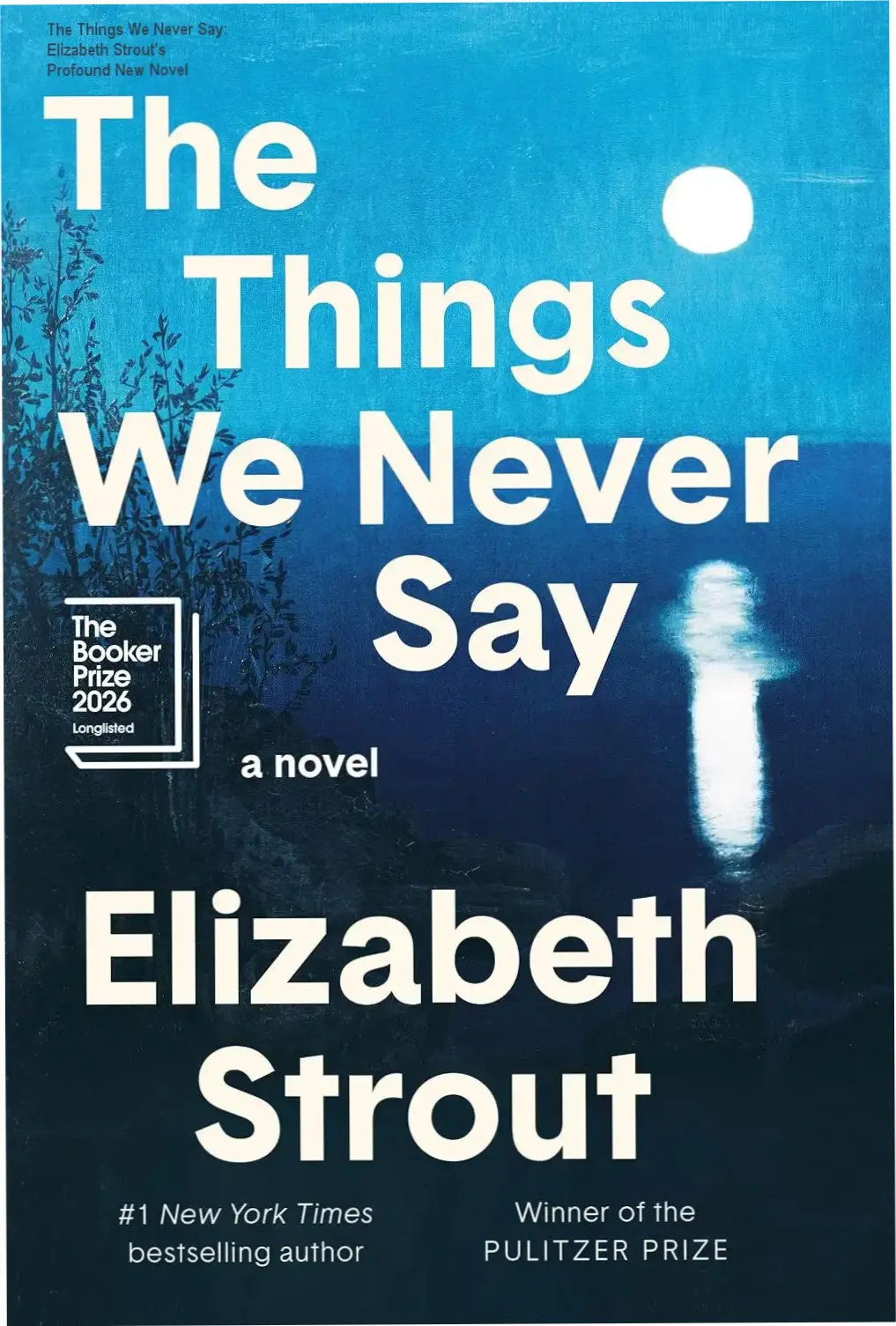
The Things We Never Say: Elizabeth Strout’s Profound New Novel

Elizabeth Strout has built a career on the quiet devastation of ordinary lives, and with The Things We Never Say, she sharpens that scalpel once more. The central tension here isn’t a plot twist—it’s the terrifying gap between the performance of a life and the reality of the consciousness living it. Artie Dam is the guy next door, the teacher who remembers your name, the husband who shows up. But underneath the sailboat rides and the holiday parties, there is a humming frequency of isolation so profound it vibrates the page. This novel speaks directly to anyone who has ever sat across from a partner of thirty years and realized they are effectively strangers sharing a mortgage. It tackles the specific, modern dread of performing “okay-ness” while the internal world fractures. Strout doesn’t offer easy catharsis; she offers witness. If you are looking for a thriller, put this down. If you are looking for a mirror held up to the silence in your own marriage or friendships, this is the book you need.
The market reception confirms the weight of the material. A New York Times bestseller and Booker longlistee before it even hit shelves, it carries the “Editors’ Pick” badge for a reason. Readers on Goodreads and Amazon aren’t just rating the prose; they are confessing. The 4.4-star average across 20,000+ reviews isn’t driven by pacing—it’s driven by recognition. People see their fathers, their husbands, themselves in Artie. The expectation going in should be calibrated for literary fiction: slow burn, interiority over action, and an ending that lingers like a half-remembered promise rather than a slammed door.
Ready to dive into “The Things We Never Say”?
Explore available editions, check current live pricing, or download a free sample directly on Amazon.
Preview Free Sample & Check Price on Amazon
*You will be redirected to Amazon. As an Amazon Associate, we may earn from qualifying purchases.
Prose Architecture: The Weight of the Unspoken
Strout’s sentence-level control is the engine of this novel. She writes in a deceptively simple register—short clauses, concrete nouns, zero adornment. But the simplicity is a trap. It lulls you into thinking you are reading a straightforward chronicle of a teacher’s year. Then a clause lands: “He looked at the world and saw only the spaces between people.” The rhythm shifts. The whitespace on the page becomes the silence between Artie and his wife, Louise.
Pacing is glacial by design. The first third is almost entirely atmospheric. We watch Artie grade papers. We watch him sail. We watch him avoid eye contact with his reflection. Readers on Reddit’s r/literature and r/books threads frequently flag this as “slow,” but the consensus among those who finish is that the slowness is the character study. You cannot understand the fracture in Artie’s world without feeling the monotony of the structure holding it up. A verified Amazon reviewer put it perfectly: “It feels like nothing happens until you realize everything has already happened.” That is the Strout signature. She refuses the dramatic inciting incident until the architecture of the ordinary is fully load-bearing.
The narrative voice stays tight to Artie’s third-person limited perspective, but it breathes. It pulls back just enough to show the town, the bay, the history classroom—contextualizing his isolation as a universal condition, not a personal failure. This isn’t stream-of-consciousness; it’s curated consciousness. Every memory surfaced serves the thesis: we are mysteries to ourselves first.
The Marriage as a Contested Border
The relationship between Artie and Louise is the novel’s beating heart. Thirty years. Two kids grown. A rhythm of compromise that has calcified into silence. Strout avoids the cliché of the explosive affair or the screaming match. The violence here is passive. It’s the tea made wrong on purpose. It’s the book left open on the chest, unread. It’s the specific loneliness of sleeping back-to-back with someone you vowed to face the world with.
Goodreads discussions highlight a fascinating split in reader sympathy. Roughly half the commentariat views Louise as the villain—cold, withholding, the architect of the silence. The other half sees her as the survivor, the one who held the fort while Artie retreated into his head. Strout writes Louise with enough opacity to sustain both readings. We never get her interiority. We only get Artie’s projection of her. That structural choice forces the reader to confront their own bias: do we blame the one who speaks, or the one who stays quiet?
The “secret” referenced in the blurb—the life-altering revelation—acts less as a plot detonator and more as a seismic shift exposing the fault lines that were always there. It forces a renegotiation of the contract. The scenes where they attempt to speak the unspeakable are excruciating in their realism. Stuttered sentences. Wrong words chosen. The physical sensation of a throat closing. This is where the book earns its “profound” label. It maps the anatomy of a difficult conversation with clinical precision and deep compassion.
| Element | Assessment | Reader Consensus |
|---|---|---|
| Prose Style | Spare, rhythmic, deceptively simple | Universally praised; “masterclass in restraint” |
| Pacing | Deliberate, interior, slow-burn | Divisive; “boring” vs. “necessary immersion” |
| Character Depth | Artie: exceptional. Secondary: functional. | Artie called “unforgettable”; others “sketched” |
| Ideal Reader Profile
This novel lands squarely for readers who value psychological precision over plot velocity. If you appreciated the quiet devastation of Olive Kitteridge or the interiority of Marilynne Robinson’s Gilead, Strout’s latest operates in that same register. It suits the reader willing to sit inside a character’s silence—the gaps between what Artie says to his students, his wife, and himself. Book clubs will find rich material in the ethics of withholding truth versus protecting dignity. It’s a book for the patient reader who understands that “nothing happens” often means “everything changes.” Who Should Probably SkipReaders chasing high-concept hooks, twist-driven narratives, or tidy resolution will feel shortchanged. The central “secret” isn’t a thriller mechanism; it’s a character study catalyst. If you require external action—affairs exposed, crimes committed, mysteries solved—to stay engaged, the 224 pages will drag. Similarly, those allergic to fragmented perspectives or Strout’s signature indirect free discourse (slipping seamlessly between narrator and character consciousness) may find the prose style elusive rather than immersive. Common Purchasing MisstepsThe marketing highlights “double life” and “secret,” priming expectations for domestic suspense. This is literary fiction wearing a thriller’s logline. Buying the hardcover expecting a page-turner leads to frustration; the tension is internal, cumulative, and linguistic. Another misstep: assuming familiarity with the Lucy Barton or Olive Kitteridge universes is required. Artie Dam stands alone. No prior Strout knowledge is needed, though veterans will recognize the tonal fingerprints—compassion laced with clinical observation. Contextual FAQIs the ending satisfying? It resolves emotionally, not narratively. Strout denies the reader catharsis through revelation; closure arrives via acceptance of ambiguity. How does it compare to Oh William!? Shorter, tighter, less expansive in timeline. It shares the preoccupation with late-life reckoning but strips the cast down to essentials. Audiobook or print? Print. The rhythm of Strout’s sentences—clauses stacking, qualifying, retreating—demands visual pacing. The narrator’s voice is competent, but the prose’s architecture is the point. Editorial SummaryThe Things We Never Say is a masterclass in restraint. At 224 pages, it carries the weight of a novel twice its length because Strout trusts the reader to do the emotional arithmetic. The value proposition is high for the right reader: profound insight per page ratio is elite. The limitation is structural—it offers no footholds for readers needing external stakes. If your shelf holds writers who dissect the ordinary until it glows, this belongs there. You can check current pricing and reader sentiment here. Final Editorial Verdict“The Things We Never Say” delivers on its core promise for its intended audience, offering compelling insights without fluff. As highlighted in our detailed edition breakdown, its practical depth and readability are its greatest strengths. We also recommend checking the official Kindle sample and reader ratings before making your final purchase decision. *You will be redirected to Amazon. As an Amazon Associate, we earn from qualifying purchases.  “Marketing de Conteúdo + Desenvolvimento Web = presença digital que gera valor.” |