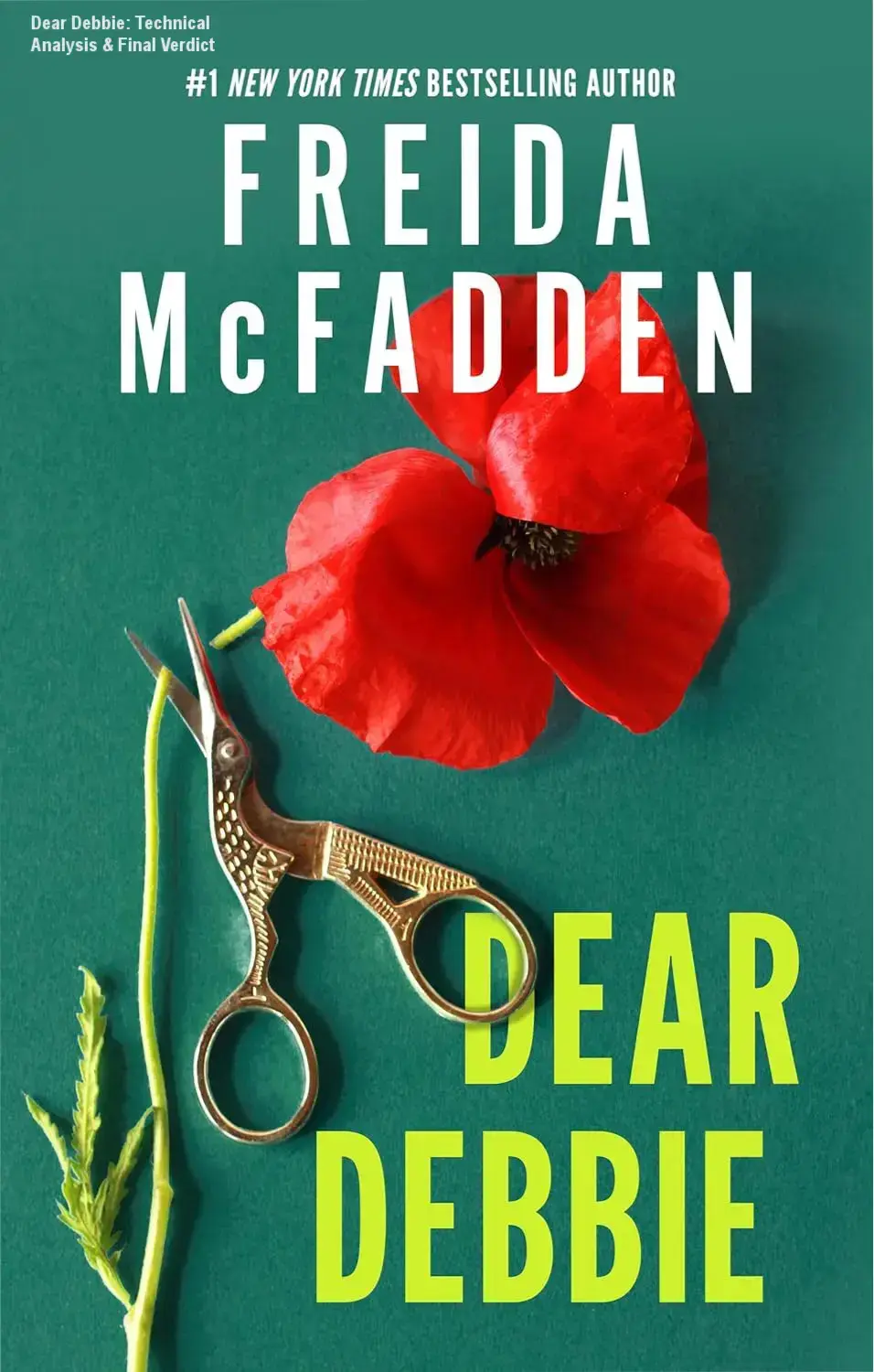
There is a specific, quiet exhaustion that comes with being the “reasonable” person in every room. We’ve all seen it—or lived it. The partner who absorbs the chaos, the employee who fixes everyone’s mistakes, the friend who provides the emotional labor while their own house is quietly burning down. This psychological pressure cooker is where Freida McFadden places her protagonist in her latest venture.
For readers who enjoy the “domestic noir” subgenre, the expectation is usually a slow burn leading to a shocking reveal. However, in a market saturated with unreliable narrators, the real draw is seeing a character finally snap. You can gauge the early anticipation and reader reception for this specific brand of female-led retribution by checking the current availability and ratings for Dear Debbie.
Ready to dive into “Dear Debbie”?
Explore available editions, check current live pricing, or download a free sample directly on Amazon.
*You will be redirected to Amazon. As an Amazon Associate, we may earn from qualifying purchases.
The “Popcorn” Pacing: Writing Style and Flow
Freida McFadden does not write literature; she writes addictive experiences. If you are looking for prose that reads like a poetic meditation on grief, look elsewhere. This is “popcorn” fiction in its purest form.
The sentences are lean. The chapters are short. The cliffhangers are calculated. It is designed for the modern attention span, making it nearly impossible to put down once the momentum kicks in.
Critics on Goodreads often point out that her style can be simplistic, but from a conversion standpoint, that is her superpower. She removes the friction between the plot and the reader. You don’t have to “work” to understand the narrative; you just slide through it.
In Dear Debbie, this pacing serves a dual purpose. It mirrors the spiraling nature of Debbie’s life. As she loses her job and discovers her husband’s secrets, the narrative speed increases, mimicking a panic attack in literary form.
The Irony of the Advice Column: Narrative Structure
The most compelling technical aspect of this book is the juxtaposition of the “Dear Debbie” column with Debbie’s actual reality. For years, she has been the voice of reason for New England’s neglected wives.
There is a biting irony here. Debbie spends her professional life telling other women how to handle toxic partners, while she herself is blind to the toxicity in her own bedroom. This creates a layer of dramatic irony that keeps the reader engaged.
The structure functions as a mirror. Each piece of advice she gives to a stranger eventually reflects back onto her own situation. When she tells a reader to “set boundaries,” we see her failing to set them with her own husband.
“It’s time to take her own advice. And now it’s time for payback.”
This transition from the “advisor” to the “executioner” is the pivot point of the book. It transforms the story from a sad domestic drama into a subversive thriller.
The “Breaking Point” Theory: Real-World Value and Themes
At its core, Dear Debbie explores the concept of the “Quiet Woman’s Rage.” It taps into a very real social phenomenon where women are conditioned to be the emotional anchors of the family, often at the expense of their own mental health.
The book asks a dangerous question: What happens when the person who is “too reasonable” finally decides that being reasonable is a losing strategy?
The introduction of the tracking app is a modern touch that resonates with current relationship anxieties. It moves the plot from suspicion to evidence, triggering the shift in Debbie’s psyche.
While the plot leans into thriller tropes, the underlying theme of reclaiming agency is where the book finds its emotional weight. It is less about the “crime” and more about the “liberation” that comes with stopping the act of being the bigger person.
Feature
Analytical Insight
Who Should Actually Read This?
Dear Debbie isn’t for the literary purist. If you are looking for nuanced prose or a slow-burn character study on the sociology of New England, look elsewhere.
This is a high-octane domestic thriller. It is designed for the “binge-reader”—someone who wants a fast-paced narrative that mirrors the addictive quality of a psychological drama series.
The ideal reader profile:
Fans of the “unreliable narrator” trope.
Readers who enjoy revenge fantasies and subversive takes on the “perfect housewife” archetype.
Those who prioritize plot twists and pacing over linguistic complexity.
Who Should Skip It?
Avoid this book if you have a low tolerance for “convenient” plot pivots. McFadden writes for maximum impact, which occasionally means characters make decisions based on the needs of the twist rather than strict logic.
If you prefer “hard” mysteries where every clue is meticulously laid out for the reader to solve before the reveal, this might feel too erratic for your taste.
Value for Money: Entertainment vs. Art
From a value perspective, you aren’t paying for a timeless classic; you are paying for a high-quality “mental palate cleanser.”
The Kindle edition is an efficient investment. The writing is lean, the chapters are short, and the information density is high. You get a complete emotional arc of descent and retribution without the fluff often found in 500-page thrillers.
Realistic Expectations (FAQ)
Is it a “how-to” on dealing with betrayal? Absolutely not. It is a fictional exploration of what happens when a woman stops being “the bigger person.”
Does it follow the typical McFadden formula? Yes. Expect a setup that feels familiar, followed by a mid-point shift that recontextualizes everything you’ve read.
Is the ending satisfying? For those who enjoy “killer results” and poetic justice, yes. For those seeking a moralistic resolution, it may feel biting.
Ultimately, the book succeeds because it taps into a universal frustration: the feeling of being ignored while providing the solution everyone secretly wants. If you’re ready for a subversive ride, you can check the latest reader ratings and pricing on Amazon.
Final Editorial Verdict
“Dear Debbie” delivers on its core promise for its intended audience, offering compelling insights without fluff. As highlighted in our detailed edition breakdown, its practical depth and readability are its greatest strengths.
Most of us spend our lives navigating systems we didn’t design, following rules we didn’t agree to, and hoping the “management” isn’t actively trying to ruin us. It is a subtle, daily grind of powerlessness. Now, imagine that system is a galactic death-game run by a sociopathic AI, and the only way to survive is…
Picture this: a cold, rain-soaked night in a bustling city, where a cryptic note and a dead body lie at the center of a mystery that could consume your every waking hour. For fans of logic puzzles and deductive reasoning, *The Killer Isn’t Alice: The 46,600 Suspect Murder Mystery Puzzle* by Iris Starling promises to…
Ruth Ware’s *The Woman in Suite 11* thrusts readers into a high-stakes game of survival, where a journalist’s quest for redemption collides with a European thriller. Lo Blacklock, haunted by past failures, sees a luxury hotel opening as her comeback ticket—until a mysterious woman’s plea for help derails her plans. The novel leans into familiar…
We have all been there: that sudden, stinging realization that a momentary lapse in judgment has 칸pushed away someone truly special. In the high-stakes world of collegiate sports and social hierarchies, mistakes aren’t justการณ์ orthodox error; they are permanent scars on one’s reputation. This is the emotionalalayacore of contemporary romance—the tension between who we are…
In the current landscape of modern fantasy, readers often face a frustrating dilemma: how to deepen their connection to a world that moves too fast. We often consume series like a whirlwind, devouring main plots while feeling a lingering emptiness for the secondary characters and the intricate lore that makes a universe feel alive. The…
Most romance readers are exhausted by the “slow burn” that takes 400 pages to reach a single kiss. There is a specific kind of frustration in watching two characters miscommunicate for three hundred chapters when all you want is the payoff. This is where the concept of the “steamy short” comes in—designed for the reader…
Utilizamos cookies para garantir que lhe proporcionamos a melhor experiência no nosso site. Se você continuar a usar este site, assumiremos que você está satisfeito com ele.