Murder by Design Review: Edison Bixby Thriller Expert Verdict

Lee Goldberg has spent decades writing television scripts where the puzzle box must snap shut in forty-two minutes minus commercials. That muscle memory is all over Murder by Design, the first entry in his Edison Bixby series. It reads less like a traditional novel and more like a premium cable pilot: high concept, banter-heavy, and ruthlessly paced. The central hook is irresistible. A brilliant insurance investigator with a traumatic brain injury loses his social filter, turning every interaction into a weaponized truth bomb. He needs a handler. Enter Wally Nash, a failed actor hired essentially to apologize for Bixby before the bodies get cold.
If you have ever groaned at the “genius jerk” trope — think House or The Mentalist — but secretly crave the competence porn of watching a master dissect a locked room, this book sits in that specific Venn diagram. Goldberg leans into the artificiality. The murders aren’t committed with knives or poison; they are engineered through bad lighting, slippery floor coefficients, and staircase geometry. The built environment becomes the murder weapon. It is a fresh spin on the whodunit that feels distinctly modern. You can check the current edition and reader reception here to see if the premise holds your attention.
The market is flooded with “cozy” mysteries featuring bakers and cats. This is not that. It is a “cranky” mystery. The violence is off-page, but the psychological friction is front and center. Bixby’s disability isn’t window dressing; it dictates the plot mechanics. His impulsivity creates the chaos; his pattern recognition solves it. Wally provides the emotional stakes. It is a buddy cop movie where one cop designs buildings and the other one just wants a paycheck.
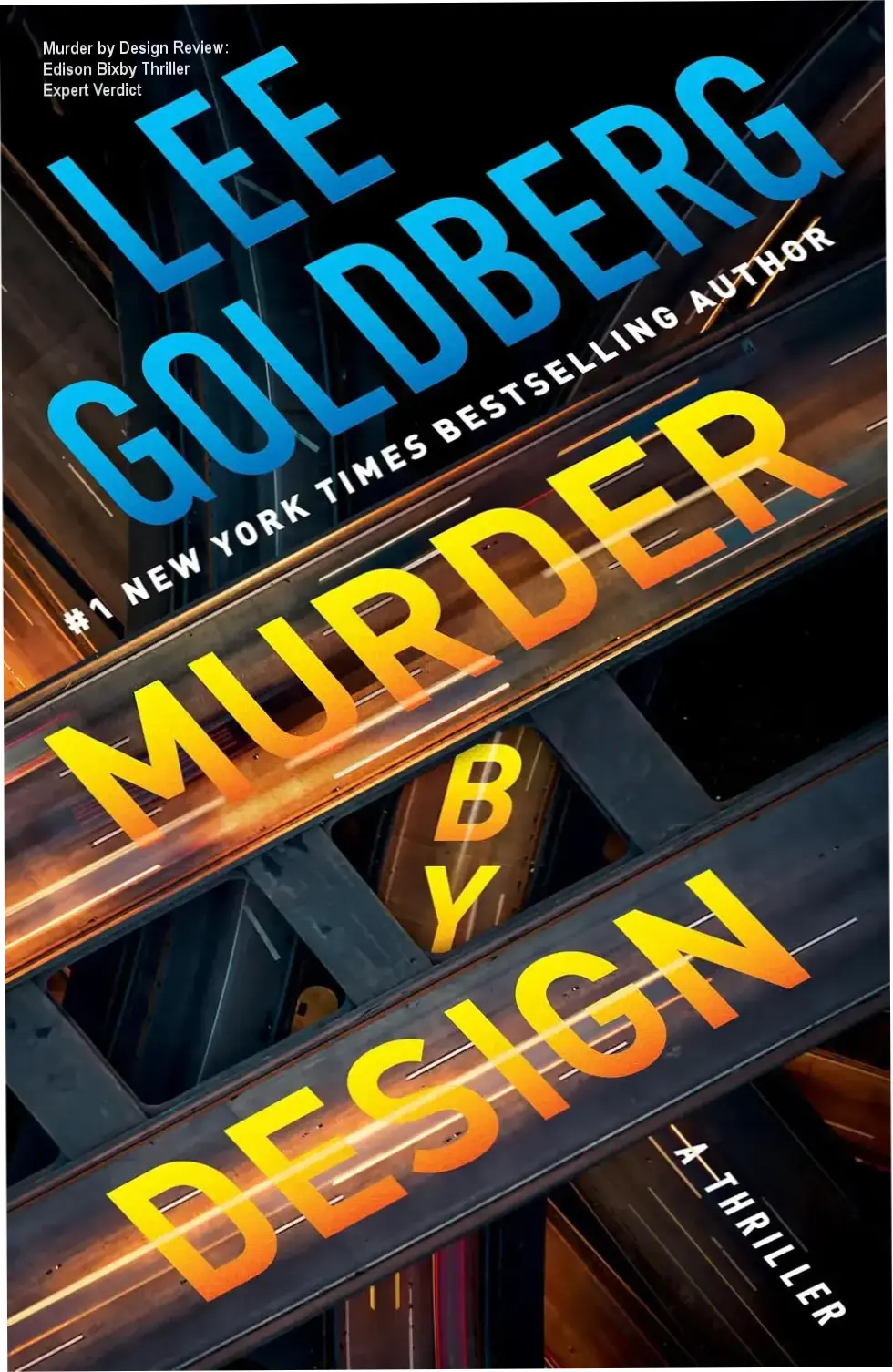
Ready to dive into “Murder by Design: A Thriller (Edison Bixby Book 1)”?
Explore available editions, check current live pricing, or download a free sample directly on Amazon.
Preview Free Sample & Check Price on Amazon
*You will be redirected to Amazon. As an Amazon Associate, we may earn from qualifying purchases.
Writing Style: Teleplay Precision Meets Page Turner Economy
Goldberg writes in sprints. Chapters are short. Scenes transition on dialogue beats. There is zero fat on the prose. You feel the showrunner DNA immediately. He establishes the “mall staircase” death in the opening pages with the clinical detachment of an actuarial table, then pivots instantly to Bixby insulting a grief counselor’s tie.
The pacing is relentless. At 236 pages (Print length), it respects your time. It clocks in around a six-hour read for average speed. No meandering subplots about the detective’s divorce or the weather in Seattle. Every sentence either advances the “design” theory or deepens the Bixby/Nash friction. Some readers on Goodreads call it “light.” I call it disciplined. It lacks the atmospheric density of Tana French or the psychological weight of Dennis Lehane. It aims for Burn Notice energy — competent professionals solving impossible problems with wit — and nails it.
The “design” explanations are the standout set pieces. Goldberg (or his researchers) knows building codes. He explains the “tread depth” and “riser height” variance that triggers a fatal misstep without turning the page into a textbook. It is exposition disguised as deduction. Very satisfying for the armchair engineer.
The Dynamic: A Subverted Holmes and Watson
Bixby is Sherlock. Wally is Watson. But the power dynamic is inverted. Watson is the competent social operator; Holmes is the liability. Wally isn’t just chronicling the genius; he is actively managing the fallout. He translates “You look fat in that dress” into “The detective means the color complements your complexion.” It is a full-time job.
This dynamic drives the humor. It also drives the heart. Wally has agency. He spots clues Bixby misses because Bixby filters the world through physics and geometry, ignoring human motive. Wally filters through desperation and ego. They need each other. The “trauma bond” feels earned, not forced. By the climax, when Wally predicts Bixby’s move before Bixby makes it, the partnership clicks.
Amazon reviewers frequently highlight this chemistry. One verified purchaser noted: “Finally a sidekick who isn’t an idiot. Wally saves Bixby as often as Bixby saves the case.” That sentiment tracks. The disability representation — Bixby’s TBI (Traumatic Brain Injury) causing disinhibition — avoids “inspiration porn.” It is a mechanic. It creates obstacles. It creates comedy. It creates tragedy. Goldberg treats it with a bluntness that matches Bixby’s personality.
The “Design” Concept: Architecture as Antagonist
This is the book’s USP (Unique Selling Proposition). The killer doesn’t pull a trigger. They specify a flooring material with a low coefficient of friction when wet. They design a staircase where the nosing blends into the tread. They manipulate lighting to create a “visual cliff” effect. The environment does the killing. The killer just waits.
It shifts the forensic focus from “who held the knife” to “who signed the purchase order.” Bixby reads blueprints like autopsy reports. He sees the malice in the millwork. It forces the reader to look at their own surroundings differently. That mall food court? The escalator gap? The hotel shower threshold? Potential crime scenes, all of them.
However, the concept demands suspension of disbelief. The villain must possess omniscient knowledge of the victim’s gait, footwear, and distraction level. The “Rube Goldberg” complexity of the kills strains credulity in the final act. A few Goodreads reviewers docked stars specifically for the ”
Who This Book Is For (And Who Should Skip It)
If you enjoy mysteries where the puzzle is fair, the dialogue cracks, and the protagonist isn’t a generic brooding detective, this is a strong buy. Readers who loved the Monk TV series—Goldberg wrote for it—will recognize the DNA: a brilliant, damaged lead and a long-suffering sidekick providing the emotional anchor.
It works exceptionally well for audiobook listeners. The banter between Bixby and Wally translates perfectly to audio format, making commutes or chores fly by. The “design” concept adds a fresh intellectual layer without bogging down the pace.
Skip it if: You demand gritty realism or procedural accuracy. Bixby’s deductions occasionally leap logic gaps that only fiction allows. If you hate “unlikable” protagonists—even charmingly rude ones—the first 20 pages might grate. This isn’t a dark psychological thriller; it’s a “cozy” with a high body count and a sharp tongue.
Value Proposition: Paperback vs. Kindle vs. Audio
At 236 pages, it’s a single-sitting read. The Kindle price frequently drops below a coffee, making it an impulse-buy no-brainer. The paperback feels slightly overpriced for the page count unless you collect the series. Best value: Whispersync. Switching between reading and listening highlights the comedic timing Goldberg nails.
One common misstep: buying Book 1 expecting a standalone resolution. It resolves the central case, but the Bixby/Wally arc is clearly serialized. You will want Book 2 immediately. Budget for the duology.
Quick Contextual FAQ
- Is it violent? Low on-page gore. Deaths are “designed” accidents, not slashers.
- Romance subplot? Minimal. The partnership is the relationship.
- Standalone? Case yes, characters no. Read in order.
- Similar authors? Think Richard Osman meets early Christopher Moore.
Editorial Bottom Line
Goldberg delivers a high-concept hook—architecture as murder weapon—and actually sticks the landing. The “design” gimmick isn’t window dressing; it structures the clues. Bixby’s TBI impulsivity is handled with surprising nuance, avoiding the “jerk with a heart of gold” cliché by making his disability the engine of his detection, not just a quirk.
The writing is clean, the pacing relentless, and the “Watson” character (Wally) earns his page time rather than just asking questions. It respects the reader’s intelligence. For the price of a Kindle edition, it’s one of the highest ROI entertainment hours you’ll find this year. You can grab the Kindle edition here and be reading in sixty seconds.
Final Editorial Verdict
“Murder by Design: A Thriller (Edison Bixby Book 1)” delivers on its core promise for its intended audience, offering compelling insights without fluff. As highlighted in our detailed edition breakdown, its practical depth and readability are its greatest strengths.
We also recommend checking the official Kindle sample and reader ratings before making your final purchase decision.
*You will be redirected to Amazon. As an Amazon Associate, we earn from qualifying purchases.

“Marketing de Conteúdo + Desenvolvimento Web = presença digital que gera valor.”