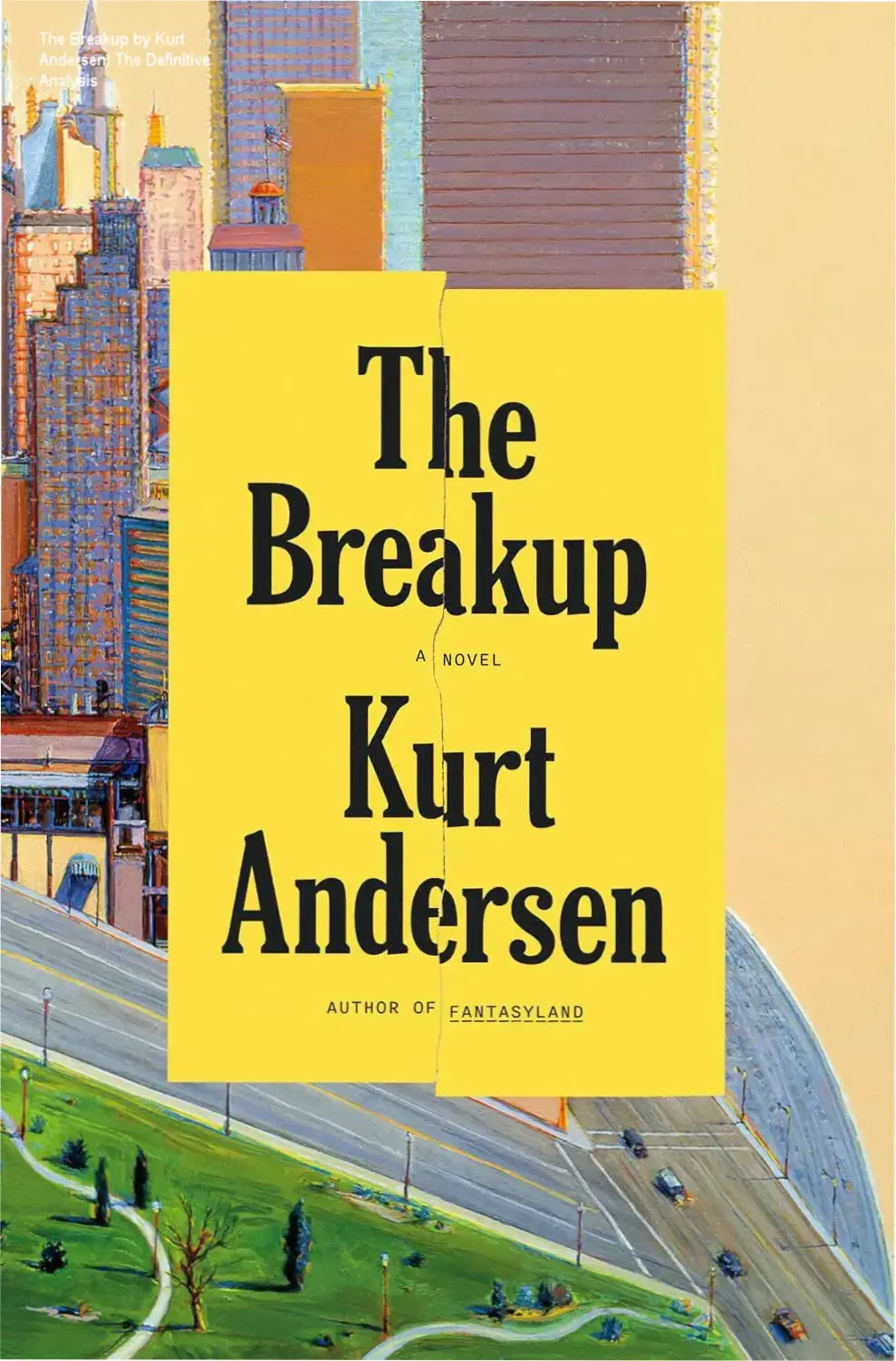
The Breakup by Kurt Andersen: The Definitive Analysis

We often think of divorce as a private tragedy, a quiet collapse of shared dreams. But what happens when the world outside your bedroom mirrors that same fragmentation? When the very ground you walk on is split by ideological borders and political violence, the “irreconcilable differences” of a marriage stop being about chores or intimacy and start being about survival.
Kurt Andersen’s “The Breakup” isn’t just another dystopian warning; it is a surgical examination of how macro-political decay erodes the micro-structures of love. For readers looking to see if the narrative holds up against the hype, you can check the current reader reception and availability here before diving into this 576-page epic.
Ready to dive into “The Breakup: A Novel”?
Explore available editions, check current live pricing, or download a free sample directly on Amazon.
Preview Free Sample & Check Price on Amazon
*You will be redirected to Amazon. As an Amazon Associate, we may earn from qualifying purchases.
The Mirror Effect: Personal vs. Political
The brilliance of Andersen’s structure lies in the symmetry. Natalie and Asher aren’t just a couple fighting; they are proxies for a fractured United States. By 2045, the country has literally split: the “Free American Republic” in the rural south and a diminished United States in the urban hubs.
Natalie is in Tennessee; Asher is in San Francisco. Their physical distance is a manifestation of their ideological void. The novel asks a brutal question: Can love survive when you no longer share the same definition of reality?
Most dystopian novels focus on the “Great War” or the “Collapse.” Andersen does something more nuanced. He focuses on the aftermath. He explores the exhausted silence that follows a civil war, making the political backdrop feel lived-in rather than performative.
| Character | Location | Ideological Anchor | Emotional State |
|---|---|---|---|
| Natalie | Free American Republic (TN) | Rural traditionalism / New Order | Resilient but isolated |
| Asher | United States (SF) | Urban liberalism / Tech-integrated | Ambivalent and drifting |
World-Building: AI and the 2045 Landscape
Andersen doesn’t lean on “magic” technology. He describes an “AI-suffused life” that feels uncomfortably plausible. The technology isn’t a robot army; it’s a layer of noise that complicates how humans communicate and perceive truth.
The setting is a character in itself. The road trip through the “strange, uncertain new American landscape” serves as a tour of a broken dream. The descriptions of transformed cities and repurposed ruins provide a visceral sense of loss.
Skeptics might find the 576-page length daunting, but the density is necessary. The author spends time detailing the “terrorist uprisings” of the 2030s not for shock value, but to explain why Natalie and Asher can no longer look at each other without seeing an enemy.
Writing Style: The Tension Between Wit and Tragedy
Coming from the author of “Fantasyland,” there is a trademark wit here. However, it’s a darker, sharper kind of humor. It’s the kind of laughter you have when everything is already on fire.
The pacing is deliberate. It doesn’t rush toward a climax. Instead, it simmers. The dialogue is “razor-sharp,” capturing the specific way people who have known each other for twenty-three years know exactly how to hurt one another.
“What differences are irreconcilable, and when is something broken worth saving?”
This central question drives the narrative. The prose fluctuates between expansive sociopolitical analysis and claustrophobic intimacy. It’s a risky balance, but it prevents the book from becoming a dry political treatise.
Expectation vs. Reality: Is it too Bleak?
If you are expecting a fast-paced action thriller about a second American Civil War, you will be disappointed. This is a literary novel. The “action” happens in the subtext and the silences between the characters.
Some readers on platforms like Goodreads have noted that the pacing can feel sluggish in the middle act. This is typical for “epic elegies.” The book is more interested in the feeling of decay than the mechanics of it.
However, the ending offers a “surprisingly hopeful” pivot. It doesn’t provide a magical cure for a divided nation, but it suggests a path for the individual. It argues that while the state may be broken, the family unit—however messy—can still find a way to breathe.
The “Road
Who Should Actually Read This?
The Breakup isn’t a fast-paced thriller. It is a slow-burn sociological study disguised as a domestic drama.
This book is for you if you enjoy “near-future” speculative fiction that feels uncomfortably plausible. If you appreciate narratives where the internal collapse of a marriage mirrors the external collapse of a nation, Andersen delivers.
It appeals to readers who prefer intellectual friction over plot-driven action. You will find value here if you are interested in how AI and political polarization physically reshape geography and human intimacy.
Who Should Skip It
Avoid this novel if you are looking for a traditional dystopian “war story.” There are no battle scenes or survivalist manuals here.
Skip this if:
- You want a quick read: At 576 pages, it demands a significant time investment.
- You dislike political commentary: The sociopolitical lens is inseparable from the plot.
- You prefer optimistic escapism: While there is a thread of hope, the primary atmosphere is one of fragmentation and loss.
Value for Money: The Analytical Trade-off
From a cost-benefit perspective, the value lies in the ambition of the world-building. Andersen doesn’t just imagine a “broken America”; he maps out the emotional debris of that break.
The risk of a “purchasing misstep” here is expecting a lean, plot-heavy novel. This is a dense, literary piece. You aren’t paying for a story; you’re paying for a perspective on 2045.
Editorial Verdict: Is it Worth the Investment?
The book succeeds because it avoids the cliché of “the end of the world.” Instead, it explores the “world after the end”—the awkward, messy reality of living in the ruins of a former superpower.
It is a challenging read, but the payoff is a penetrating look at whether some things, once broken, are simply beyond repair. For those who value depth over speed, it is a strong acquisition.
To see how other readers are reacting to this vision of the future, you can check the latest user reviews and ratings on Amazon.
Final Editorial Verdict
“The Breakup: A Novel” delivers on its core promise for its intended audience, offering compelling insights without fluff. As highlighted in our detailed edition breakdown, its practical depth and readability are its greatest strengths.
We also recommend checking the official Kindle sample and reader ratings before making your final purchase decision.
*You will be redirected to Amazon. As an Amazon Associate, we earn from qualifying purchases.

“Marketing de Conteúdo + Desenvolvimento Web = presença digital que gera valor.”