We’ve been conditioned to believe that “disruption” is a neutral term. When a tech giant breaks a legacy industry, we call it innovation. We accept the chaos as the price of a faster app or a cheaper ride.
But what happens when the thing being disrupted isn’t a taxi service, but the concept of elected government? Gil Durán’s analysis suggests we are no longer dealing with clumsy engineers, but with a calculated blueprint for digital feudalism. You can check the current reception of The Nerd Reich to see how this warning is landing with readers who are tired of the “techno-optimism” facade.
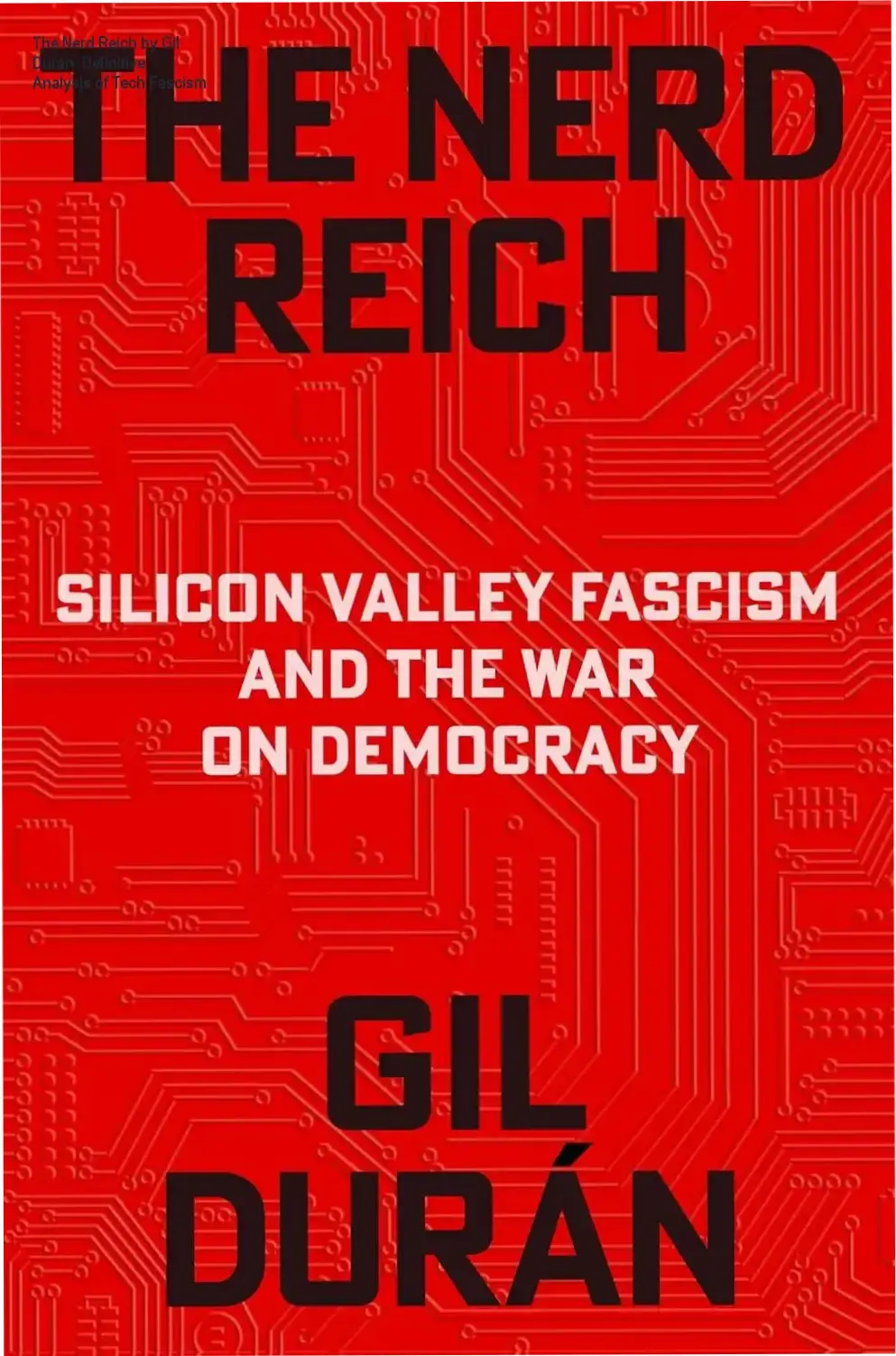
Ready to dive into “The Nerd Reich: Silicon Valley Fascism and the War on Democracy”?
Explore available editions, check current live pricing, or download a free sample directly on Amazon.
*You will be redirected to Amazon. As an Amazon Associate, we may earn from qualifying purchases.
The Great Deception: Innovation as a Trojan Horse
Durán doesn’t start with a conspiracy theory. He starts with a pattern. For decades, Silicon Valley has operated under the mantra of “moving fast and breaking things.”
To the average user, this meant better UX. To the venture capitalist, it meant market dominance. But Durán argues that for a specific elite, “breaking things” referred to the social contract itself.
The book strips away the glossy veneer of the “genius billionaire.” It posits that the goal isn’t to improve democracy through technology, but to replace it with corporate rule.
This isn’t a sudden shift. It is a slow-burn campaign. The author meticulously traces how the tools of liberation—the internet, open source, decentralization—were weaponized into tools of surveillance and control.
The “Nerd Reich” isn’t about uniforms or marches. It is about code. It is about who owns the algorithm and who decides what is “true” in a digital square.
The Philosophical Blueprint: The Sovereign Individual
One of the most critical sections of the book is the deep dive into The Sovereign Individual. If you haven’t heard of this text, you should. It is essentially the “bible” for the tech-authoritarian movement.
Durán explains how James Dale Davidson and Lord William Rees-Mogg predicted a world where the wealthy could opt out of the state entirely.
The logic is simple: if you have enough capital and the right technology, you no longer need a government to provide security or law. You create your own.
This isn’t just theoretical. Durán connects these 90s theories to the current obsession with “network states” and cryptocurrency. It is a roadmap for escaping the “burden” of citizenship.
“Democracy is being dismantled not by coups or tanks, but by code, capital, and the illusion of innovation.”
The skepticism here is palpable. The author challenges the reader to stop seeing crypto as a financial tool and start seeing it as a political weapon designed to bankrupt the public sector.
The Public Narrative
The “Nerd Reich” Reality
Decentralization for empowerment
Evasion of tax and legal accountability
<
Who This Book Is Actually For
The Nerd Reich isn’t a casual read. It’s a systemic autopsy of power. You should pick this up if you are a political strategist, a tech skeptic, or someone who feels that “innovation” has become a euphemism for “evading the law.”
It is specifically designed for readers who want to understand the philosophical connective tissue between the 1990s’ The Sovereign Individual and the current obsession with “Network States” and AI-driven governance.
Who Should Skip It
The Tech-Optimists: If you believe that disruption is always a net positive and that billionaires are inherently benevolent, this book will feel like an attack.
The “Quick-Fix” Reader: This isn’t a “5 tips to survive AI” manual. It is a dense, investigative narrative.
Neutrality Seekers: Gil Durán is not attempting to be a neutral observer. He is sounding an alarm. If you require academic detachment, look elsewhere.
Common Purchasing Missteps
The biggest mistake readers make with this title is expecting a technical guide to cryptocurrency or AI. It is not that.
It is a political critique. The tech (crypto, algorithms, AI) is treated as the tool, not the subject. You are buying a study on digital feudalism, not a tutorial on blockchain.
Editorial Verdict: Value vs. Cost
At 352 pages, the value lies in the synthesis. Durán connects the dots between San Francisco’s weaponized local elections and the global ambition of the “technocrat” class.
Is it alarmist? Yes. But it’s a calculated alarm. The book provides a roadmap of how code is replacing legislation, making it an essential piece of intellectual armor for anyone navigating the 2020s.
For those who want to see the blueprint of the “corporate rule” replacing elected governments, the investment is easily justified. You can verify the current community reception and check for available discounts via the official product page.
Final Editorial Verdict
“The Nerd Reich: Silicon Valley Fascism and the War on Democracy” delivers on its core promise for its intended audience, offering compelling insights without fluff. As highlighted in our detailed edition breakdown, its practical depth and readability are its greatest strengths.
We have all been there: that sudden, stinging realization that a momentary lapse in judgment has 칸pushed away someone truly special. In the high-stakes world of collegiate sports and social hierarchies, mistakes aren’t justการณ์ orthodox error; they are permanent scars on one’s reputation. This is the emotionalalayacore of contemporary romance—the tension between who we are…
In an era of hyper-accurate weather apps and real-time satellite tracking, the idea of buying a physical book to predict the climate feels almost rebellious. We have succumbed to the “algorithm,” trusting a screen to tell us when to plant tomatoes or if it will rain during our weekend trip. Yet, there is a growing,…
Navigating the complexity of unexpected connections is a universal human struggle, whether in real life or through the lens of fantasy. We often assume that finding “the one” solves everything, but reality—and good literature—proves that multiple connections can create chaos. In the paranormal romance genre, readers often seek an escape from these complexities, yet they…
Most of us have a secret obsession with “cold cases.” There is something inherently magnetic about a mystery that has remained unsolved for decades, especially when it involves a glamorous icon from a bygone era. The problem is that most modern thrillers are either too violent or too fast-paced to feel authentic. Readers are increasingly…
Most readers dive into historical fantasy seeking a clean escape, but the best narratives are those that mirror our own chaotic political climates. We often mistake “royal fantasy” for mere fluff, forgetting that the core of these stories is usually about the crushing weight of expectation and the fragility of power. When you pick up…
We often romanticize the idea of escaping our problems by moving to a coastal town, thinking a change of scenery is the ultimate fix for a fractured life. We imagine small-town charm as a cure for burnout or family legacy pressures, ignoring the messy reality of rebuilding a life from scratch. Meghan Quinn’s latest work…
Utilizamos cookies para garantir que lhe proporcionamos a melhor experiência no nosso site. Se você continuar a usar este site, assumiremos que você está satisfeito com ele.