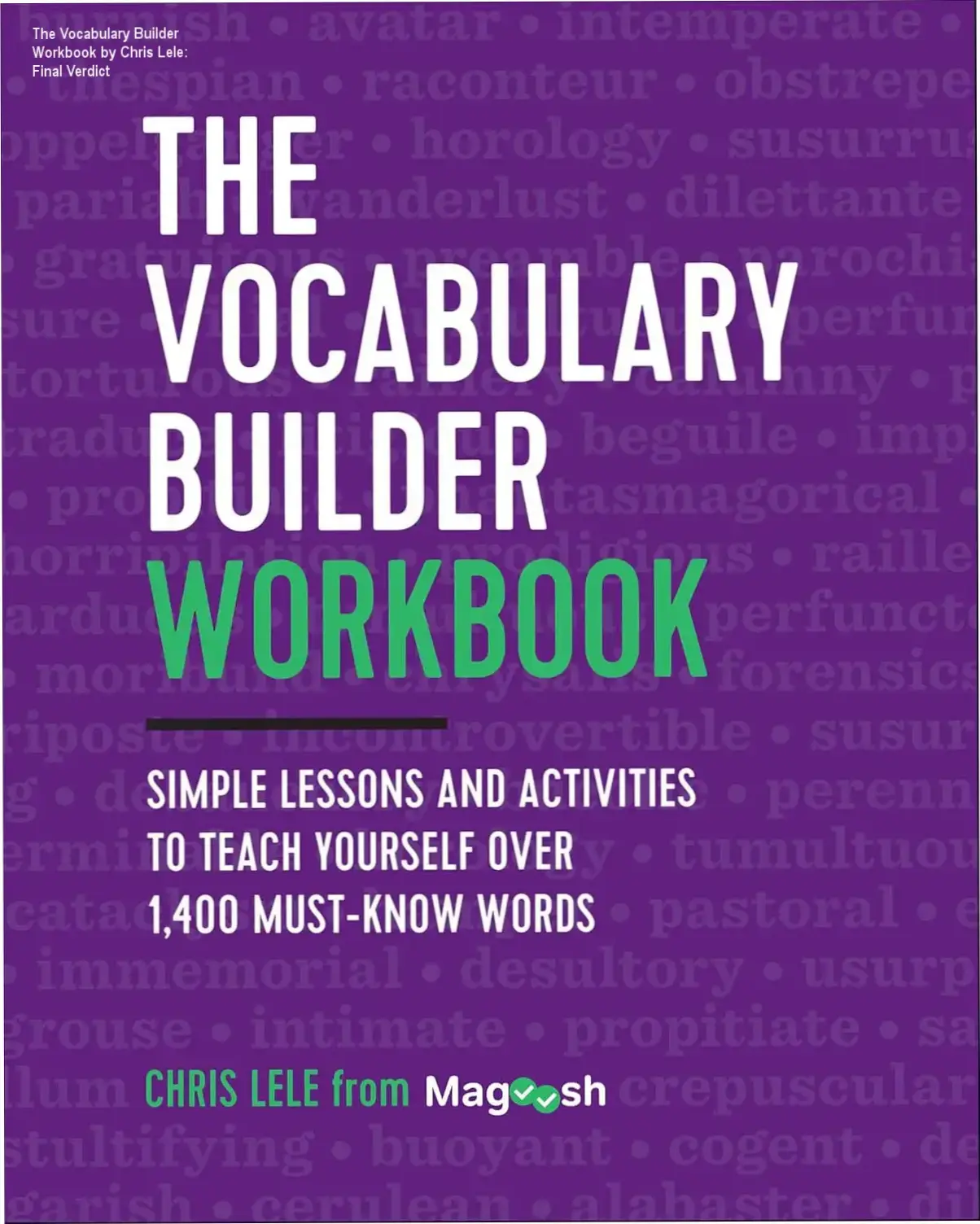
The Vocabulary Builder Workbook by Chris Lele: Final Verdict

Most people approach vocabulary expansion like a chore. They memorize a list of obscure words, use them once in a sentence that sounds forced, and forget them by Tuesday. It is the classic “flashcard trap”—rote memorization that lacks context and fails to stick because the brain doesn’t see a reason to keep the information.
The reality is that true linguistic fluency isn’t about knowing the most words; it’s about knowing how words are built. Whether you are staring down a GRE exam or trying to sound less repetitive in corporate emails, the gap is usually a lack of structural understanding. This is where The Vocabulary Builder Workbook attempts to pivot from mindless repetition to a system of patterns and associations.
Ready to dive into “The Vocabulary Builder Workbook”?
Explore available editions, check current live pricing, or download a free sample directly on Amazon.
Preview Free Sample & Check Price on Amazon
*You will be redirected to Amazon. As an Amazon Associate, we may earn from qualifying purchases.
The “Anti-Flashcard” Philosophy: Roots and Associations
Chris Lele doesn’t just give you a dictionary in workbook form. The core argument here is that vocabulary is a puzzle. If you learn the “root,” you unlock a dozen other words without even trying.
Instead of teaching “benevolent” as a standalone term, the book guides you through the root bene (meaning well or good). Once that clicks, words like beneficial, benign, and benefactor stop being separate entities and start becoming a family.
This is a high-leverage strategy. It transforms the learning process from a linear climb (one word at a time) to an exponential growth curve. You aren’t just learning 1,400 words; you’re learning the DNA of the English language.
From a CRO perspective, this “system” is the product’s strongest selling point. It promises a shortcut to mastery by reducing the cognitive load required for memorization.
| Feature | Traditional Learning | Lele’s Workbook Approach |
|---|---|---|
| Method | Rote Memorization | Root-based Associations |
| Retention | Short-term (Exam focus) | Long-term (Structural understanding) |
| Effort | High (Linear) | Medium (Exponential) |
The Learning Curve: From “Easy” to “Academic”
The pacing of this book is intentionally progressive. It doesn’t throw you into the deep end with archaic Latin terms on page one. It starts with accessible concepts and steadily cranks up the difficulty.
For a student prepping for the SAT or GRE, this is vital. These tests don’t just test your knowledge; they test your ability to handle increasing complexity under pressure.
However, for the casual reader, this progression can feel slow at first. Some users on Goodreads have noted that the beginning sections feel “too simple.” But that’s the trap—skipping the basics often leads to gaps in the later, more complex thematic blocks.
The structure is lean. Each lesson is thematic, which helps the brain categorize information. Instead of a random list, you get “words about power” or “words about emotion,” creating a mental filing system that makes retrieval faster during actual conversation or writing.
Active Participation vs. Passive Reading
Let’s be skeptical for a second: can a workbook actually “teach” you a language? Most “learning” books are just textbooks in disguise. You read them, you feel like you understand, and then you fail the application.
The “Workbook” part of this title isn’t marketing fluff. The inclusion of activities—fill-in-the-blanks, matching, and contextual exercises—forces the brain to move from passive recognition to active recall.
Recognition is knowing a word when you see it. Recall is being able to produce that word when you need it. This is the difference between a C-student and an A-student on a standardized test.
“The exercises actually make you think about how the word fits into a sentence, rather than just matching it to a definition. That’s where the real learning happens.”
This active loop is what drives the high rating (4.6 stars). It turns the book into a tool rather than a lecture. You aren’t just consuming content; you are practicing a skill.
The Target Audience: Who is this actually for?
If you are a native English speaker with a PhD in Literature, this book will be a waste of your time. It is too basic. But for
Who Should Actually Buy This Book?
This workbook isn’t for the casual reader who hopes to absorb new words by osmosis. It is a tool for active learners. Specifically, it fits three profiles:
- The Test-Taker: Students prepping for the SAT, ACT, or GRE who need a structured way to tackle high-frequency academic words.
- The Professional: Individuals who feel their vocabulary is “plateauing” and want to sound more precise and authoritative in corporate environments.
- The Disciplined Student: Anyone who prefers a “drill-and-practice” methodology over immersive reading.
Who Should Skip It?
Avoid this purchase if you are looking for a “magic pill.” If you despise repetitive exercises, fill-in-the-blanks, and structured lessons, you will find this tedious. This is a workbook, not a narrative. If your goal is to learn vocabulary through the beauty of literature or organic conversation, a structured manual will feel like a chore.
Common Purchasing Missteps
The biggest mistake buyers make is treating this as a reference book. It is not a dictionary. You cannot simply flip to a page and “find” a word.
The value lies in the progressive approach. If you skip the foundational lessons on roots and associations to jump straight to the harder words, you defeat the entire purpose of Chris Lele’s method. You are paying for the system of retention, not just a list of 1,400 words.
Value for Money: The Verdict
From a cost-benefit perspective, the investment is low compared to the potential ROI of a higher test score or improved professional communication. Most vocabulary apps are fragmented; this provides a cohesive roadmap.
The “hidden” value is the focus on etymology and roots. By teaching you how words are built, the book effectively gives you the keys to unlock thousands of words not explicitly listed in the text.
If you have the discipline to complete the activities, it’s a bargain. To see if the current pricing matches your budget, you can check the live discounts on Amazon.
Final Editorial Verdict
“The Vocabulary Builder Workbook” delivers on its core promise for its intended audience, offering compelling insights without fluff. As highlighted in our detailed edition breakdown, its practical depth and readability are its greatest strengths.
We also recommend checking the official Kindle sample and reader ratings before making your final purchase decision.
*You will be redirected to Amazon. As an Amazon Associate, we earn from qualifying purchases.

“Marketing de Conteúdo + Desenvolvimento Web = presença digital que gera valor.”