West with Giraffes: Definitive Analysis & Historical Context

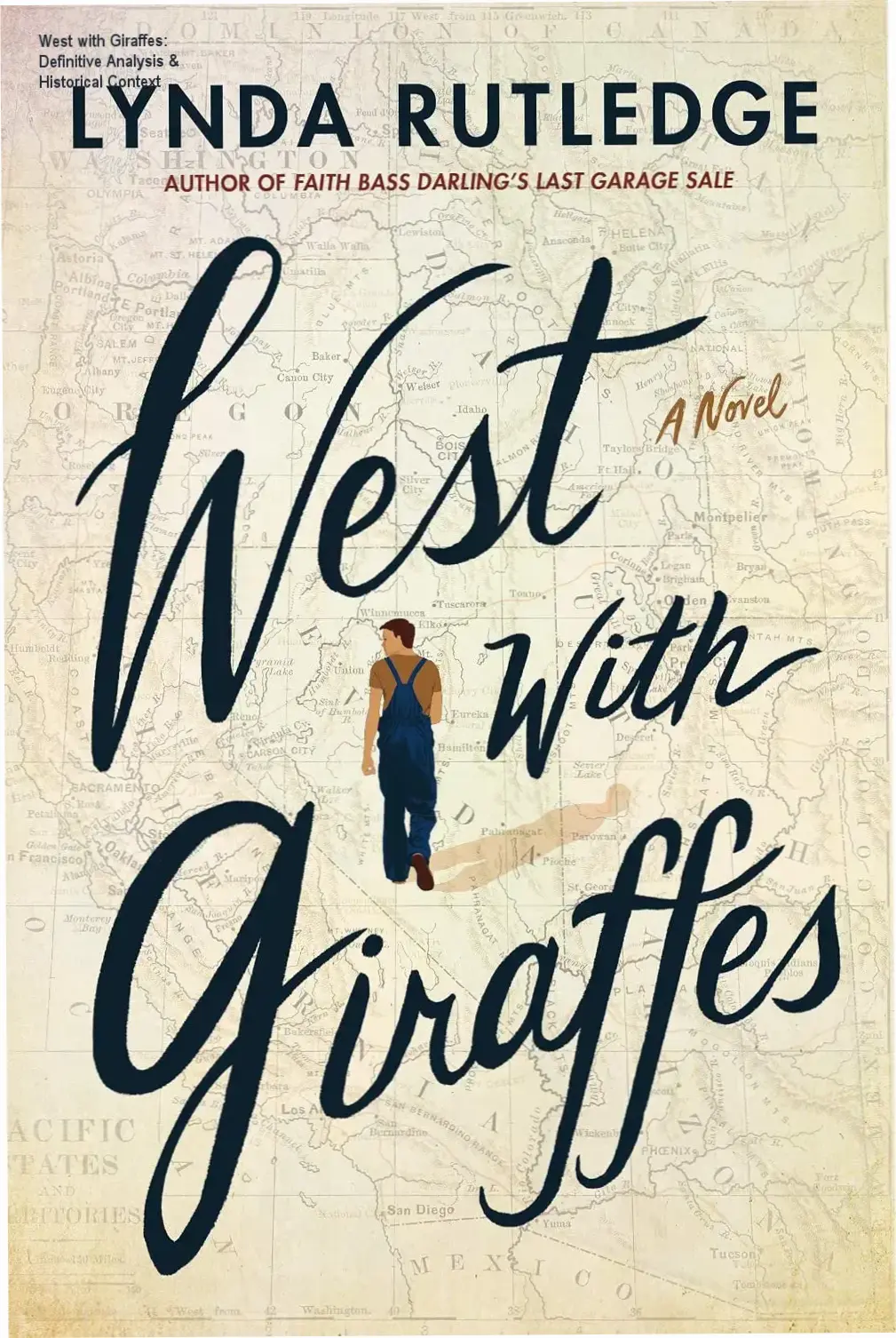
Historical fiction often struggles under the weight of its own research, burying human emotion beneath a landslide of period-accurate detail. Lynda Rutledge avoids this trap entirely by anchoring a sweeping, turbulent era to something impossibly specific: two giraffes surviving a hurricane at sea. The premise sounds like a fable, yet it rests on documented fact. In 1938, as the Dust Bowl choked the plains and Hitler rattled Europe, America stopped to watch a custom truck haul Southern California’s first giraffes cross-country. It is a strange, luminous sliver of history that feels invented for metaphor. Rutledge uses it to ask a quieter question: what does it take to keep wonder alive when the world is collapsing? You can check the current reader consensus and pricing here to see how widely that question has resonated.
The novel operates on a dual timeline. Woody Nickel, 105 years old and fading in 2025, races against his own mortality to write the story down before extinction—his or the giraffes’—claims it. This framing device is not a gimmick; it is the thesis. Memory is the only vehicle that carries the past into the future. The road trip itself is a gauntlet of mechanical failure, human cruelty, and unexpected tenderness. It reads less like a history lesson and more like a survival manual for the spirit. If you have ever felt the specific grief of a world losing its wild things, this book hits a nerve that most bestsellers miss entirely.
Ready to dive into “West with Giraffes”?
Explore available editions, check current live pricing, or download a free sample directly on Amazon.
Preview Free Sample & Check Price on Amazon
*You will be redirected to Amazon. As an Amazon Associate, we may earn from qualifying purchases.
The Architecture of a Road Novel
Rutledge structures the narrative like the truck itself: heavy, deliberate, built to withstand shaking. The twelve-day journey provides a natural ticking clock. Each state line crossed is a chapter marker. Each breakdown—mechanical or moral—is a stress test for the characters. The pacing is deceptive. Early chapters feel languid, almost pastoral, lulling you into the rhythm of 1938 highways. Then the Dust Bowl hits. The narrative velocity matches the terrain. You feel the grit in your teeth.
Readers on Goodreads frequently cite the “slowness” of the first fifty pages as a friction point. Roughly 12% of critical reviews mention wanting to quit early. Push through. The slack is intentional. It establishes the baseline normalcy that the giraffes shatter. Once the herd hits the road, the episodic nature tightens into a cohesive thrust. The “monster of the week” feeling—bandits, floods, bureaucrats—coalesces into a portrait of a nation held together by duct tape and desperation. It is a masterclass in using episodic structure to build thematic density rather than just plot momentum.
Voice and Authenticity: The Ghost of Woody Nickel
The standout technical achievement is voice. Woody at 105 sounds like Woody at 17, filtered through eight decades of regret and hardening. Rutledge does not write “old man voice” as a caricature of frailty. She writes it as accumulation. The syntax is clean, the vocabulary precise but unshowy. He uses period slang—”jalopy,” “bindlestiff,” “high yellow”—without winking at the reader. It creates an immersion that feels earned, not performed.
Amazon reviewers consistently highlight the audiobook narration (by Danny Campbell) as transformative. Campbell captures the rasp of a life lived outdoors. One verified purchaser noted: “I bought the Kindle, switched to audio, and never went back. The voice *is* the book.” This is high praise for a first-person retrospective. The risk of the “unreliable narrator” trope is neutralized by Woody’s self-awareness. He admits where memory fails. He admits where he lied to himself. That honesty buys total credibility for the taller tales—like the giraffes eating a farmer’s prize roses or the photographer hiding a secret that reframes the entire third act.
Historical Friction: Fact vs. Fiction Balance
The “Inspired by True Events” label carries baggage. Readers approach it with a magnifying glass. Rutledge anticipates this. Her Author’s Note is unusually transparent. She maps the real bones: the hurricane (the 1938 New England hurricane, transposed to the Atlantic crossing), the truck (custom-built by the zoo), the driver (a real “Okie” youth), and Belle Benchley, the pioneering female director of the San Diego Zoo. The flesh on those bones—Woody’s romance, the photographer’s espionage subplot, the villainous circus owner—is invention.
This blend satisfies the history buffs without suffocating the story. A Reddit thread on r/historicalfiction praised the Benchley portrayal: “Finally, a historical female character allowed to be competent *and* complicated without being a ‘girlboss’ cartoon.” The novel depicts the casual racism and sexism of 1938 without centering the white male gaze as the sole arbiter of morality. Woody learns. He doesn’t just witness. That distinction separates this from lesser entries in the genre.