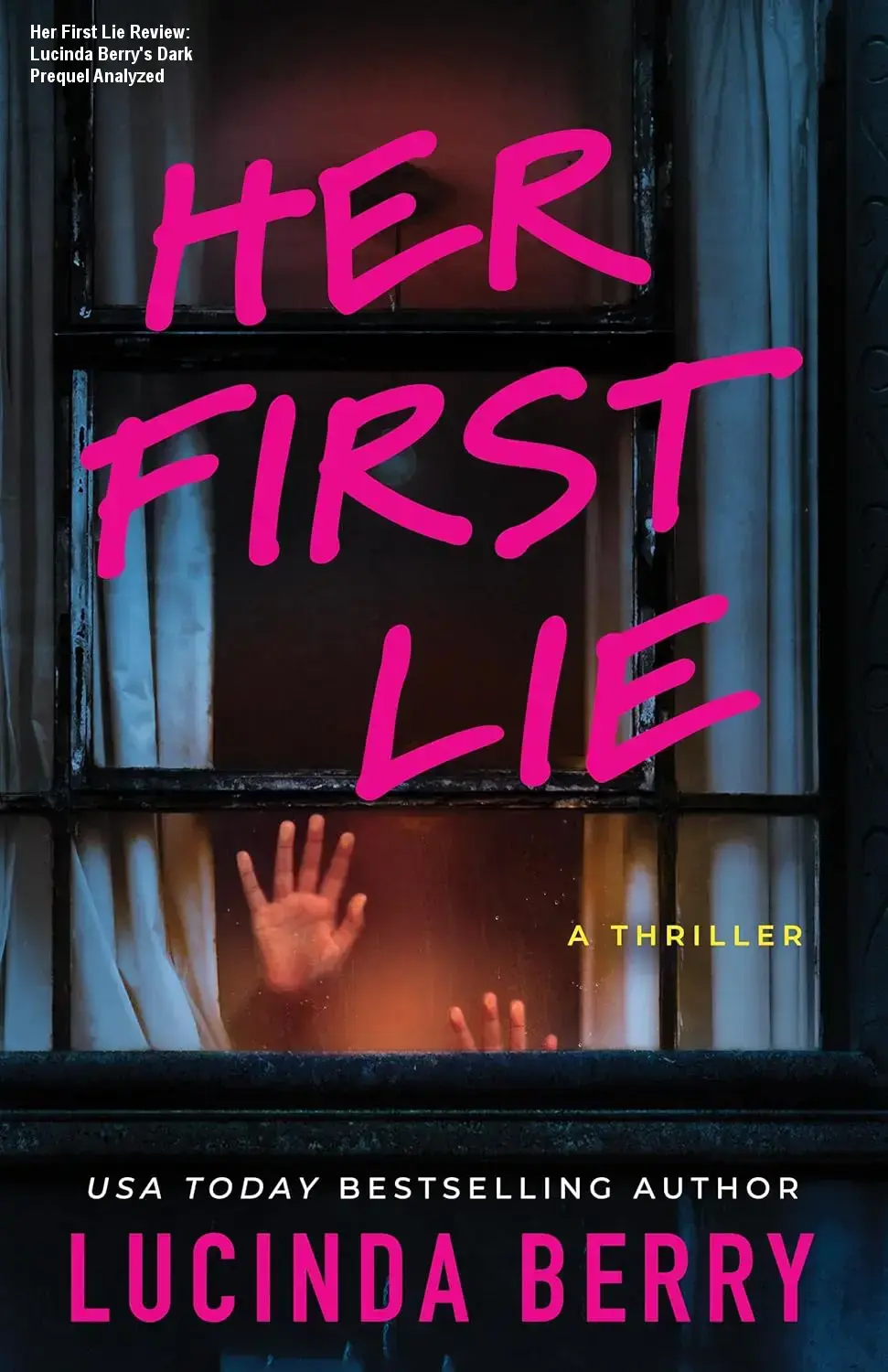
Her First Lie Review: Lucinda Berry’s Dark Prequel Analyzed

Family secrets rarely stay buried; they fester. Lucinda Berry builds her prequel, Her First Lie, on that exact premise, dragging the Watson family skeleton out of the closet before the events of The Perfect Child. We meet Becky at her breaking point: a college freshman, alone, hiding a newborn in a dorm room. It is a raw, visceral opening that refuses to look away. The novel asks a uncomfortable question: how far will a mother go to protect her child when the only help offered comes with strings attached? If you want to see where this generational nightmare begins, check the current edition and reader reviews on Amazon.
Berry writes with the clinical precision of a psychologist — because she is one. That background bleeds into every page. She doesn’t just tell you trauma exists; she maps the neural pathways of survival. Becky’s foster care history isn’t backstory decoration. It is the operating system running her every decision. Lillian, the grandmother, arrives like a deus ex machina in a luxury SUV, but the savior complex masks a puppeteer’s control. The tension isn’t “what happens next.” It is “what has already happened that we haven’t seen yet.”
Ready to dive into “Her First Lie”?
Explore available editions, check current live pricing, or download a free sample directly on Amazon.
Preview Free Sample & Check Price on Amazon
*You will be redirected to Amazon. As an Amazon Associate, we may earn from qualifying purchases.
Writing Style: Clinical Precision Meets Visceral Panic
Berry’s prose is lean. She strips sentences down to muscle and bone. There is zero literary fat here. You won’t find pages of atmospheric description of the dorm room. You will find the smell of sour milk, the sound of a RA’s footsteps, the calculation of seconds before discovery.
The pacing is a slow burn that accelerates into a sprint. The first third establishes the suffocating isolation. The middle introduces Lillian and the false safety. The final act is a cascade of revelations. Some readers on Goodreads complained the middle “dragged.” I disagree. That drag is the manipulation. It mimics the grooming process. You feel Becky’s guard lowering because the narrative forces you to lower yours.
Dual timelines (Becky now, Lillian then) are handled with clear headers. No confusion. The transitions serve the theme: the past is not past. It is the blueprint.
Core Themes: The Inheritance of Damage
This is not a thriller about a stalker or a serial killer. The antagonist is generational trauma wearing a cardigan. The “First Lie” of the title isn’t a single event. It is the foundational lie mothers tell daughters: “I did this for you.”
Motherhood as Hostage Situation: Becky loves Janie. That love is the lever Lillian pulls. Berry explores the terrifying reality that maternal instinct can be weaponized against the mother. It’s a theme discussed heavily in Reddit threads (r/thrillerbooks, r/books). Readers who are parents found the dorm scenes physically difficult to read. Child-free readers called it “manipulative fiction.” Both reactions prove the writing works.
Systems Failure: The foster care system, the campus housing policy, the legal loopholes Lillian exploits — Berry indicts the structures that leave vulnerable women with zero good options. Becky doesn’t choose Lillian. She chooses the only door that isn’t locked.
Character Study: No Heroes, Only Survivors
Becky Watson is prickly, distrustful, and makes terrible decisions. She lies to everyone. She lies to herself. She is entirely believable. A “likable” protagonist would have broken the realism. Her CPTSD isn’t a quirk; it is a survival strategy that no longer serves her.
Lillian is the standout. She is not a cartoon villain. She bakes cookies. She knows the pediatrician. She genuinely believes she is the hero. That conviction makes her infinitely more dangerous than a mustache-twirling antagonist. Amazon reviewers frequently used the word “gaslighting” to describe her dynamic with Becky. It fits. The subtle rewriting of reality is the horror.
Orion (the childhood friend) serves as the “what if” — the life Becky could have had if the system hadn’t eaten them both. His presence is brief but pivotal. He represents unconditional witness. Something Becky has never had.