Most of us have spent a sleepless night wondering about the “one that got away.” We obsess over a single decision or a missed connection, convinced that a different choice would have led to a perfect, alternative life. It is a universal human glitch: the belief that destiny is a tangible force rather than a series of random coincidences.
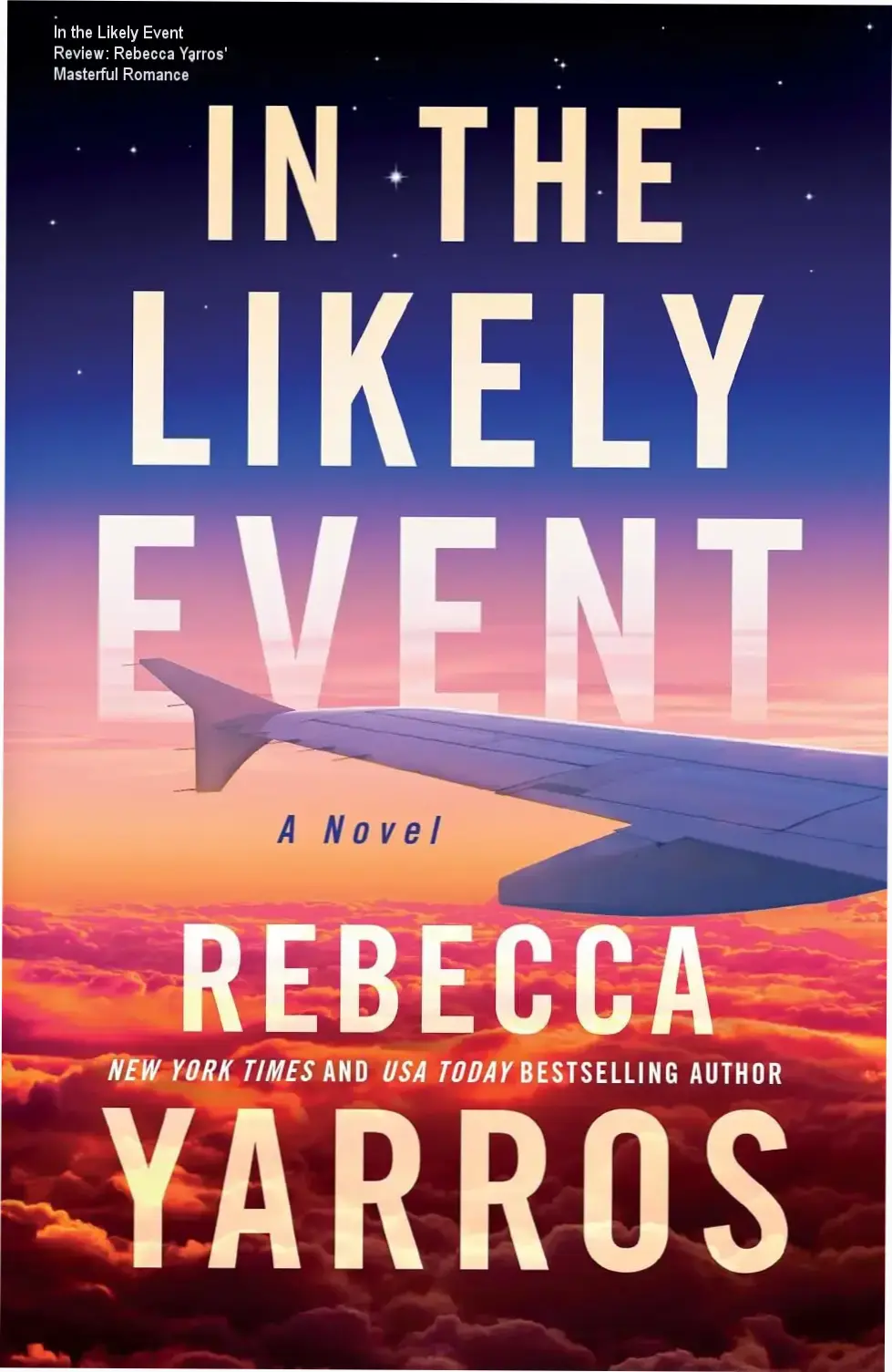
When Rebecca Yarros released In the Likely Event, she leaned heavily into this psychological tension. Coming off the massive success of Fourth Wing, the market expectation was high, but the challenge was different. Instead of dragons, readers were looking for a grounded, gut-wrenching exploration of timing and trauma. You can see how the community has reacted to this emotional gamble by checking the reader reception and current editions here.
Ready to dive into “In the Likely Event”?
Explore available editions, check current live pricing, or download a free sample directly on Amazon.
*You will be redirected to Amazon. As an Amazon Associate, we may earn from qualifying purchases.
The Architecture of Chance: Pacing and Narrative Structure
The book doesn’t just tell a story; it manipulates time. Yarros uses a structure that mirrors the chaos of the characters’ lives. We start with an instant, high-voltage connection that is immediately severed by a catastrophe.
The plane crash serves as more than a plot device. It is the catalyst for a lifelong psychological tether. By ripping the protagonists apart just as they find common ground, the narrative creates a “deficit” that the reader feels throughout the entire book.
The pacing is aggressive. Yarros doesn’t waste time on filler. She jumps through years, showing us glimpses of Izzy and Nate as they evolve separately. This “stop-and-go” movement keeps the tension high because you are constantly waiting for the next collision.
However, a skeptical reader might find the “chance encounters” over the years a bit too convenient. It borders on the improbable. But in the realm of contemporary romance, this is often the “sugar” that makes the angst palatable.
Character Archetypes: The Soldier and the Strategist
Nate Phelan is the classic rugged military archetype, but with a layer of vulnerability that prevents him from becoming a caricature. His protectiveness isn’t just a romantic trope; it’s a trauma response.
Izzy Astor provides the necessary counterbalance. Her trajectory into politics isn’t just a career choice; it represents her need for control in a world that proved, via a plane crash, that control is an illusion.
The chemistry between them is built on shared trauma. This is a risky narrative move. If not handled correctly, the romance can feel like a byproduct of PTSD rather than genuine love.
Yarros manages this by focusing on their intellectual and emotional compatibility. They don’t just need each other to heal; they actually like who the other person has become in the intervening years.
“The tragedy isn’t that they lost each other. The tragedy is that they found each other at every wrong moment until the only moment left was the most dangerous one.”
Reader Sentiment: The Goodreads and Reddit Consensus
With over 129,000 ratings on Goodreads, the consensus is clear: this is an “emotional wreck” of a book. Many readers report that the book’s strength lies in its ability to make the reader feel the passage of time.
On Reddit, discussions often center on the “Right Person, Wrong Time” trope. Some critics argue that the plot relies too heavily on coincidence. They question why the characters didn’t simply find each other via the internet or mutual acquaintances in a connected world.
Yet, the majority of the fanbase defends this. They argue that the emotional payoff—the reunion in Afghanistan—outweighs the logistical plot holes. The stakes are raised from “will they date?” to “will he keep her alive?”
This shift in stakes is where the book wins. It transforms a standard romance into a high-stakes thriller, which keeps the momentum from sagging in the middle act.
<
Who This Book Is For (And Who Should Skip It)
This novel targets readers who crave emotional weight alongside their romance. If you loved the high-stakes tension of Fourth Wing but want a contemporary setting, the prose style translates well. It suits fans of “right person, wrong time” tropes spanning decades.
Military romance enthusiasts will appreciate the authenticity in Nate’s trajectory. Yarros writes that world with lived-in detail, not just decorative uniforms. Political backdrop followers get a competent look at campaign mechanics without drowning in jargon.
Skip it if: You need fast pacing from page one. The first act breathes. You dislike non-linear storytelling; the time jumps are structural pillars, not gimmicks. You want closed-door intimacy—this runs hotter than sweet, cooler than explicit.
Readers allergic to “fated mates” energy might find the initial plane-meet-cute strained. The “destiny” hook is literal here. If that phrasing makes you roll your eyes, the subsequent 300 pages won’t change your mind.
Value Proposition: Hardcover vs. Kindle vs. Library
At 348 pages, the Kindle edition ($9.99 list) offers solid cost-per-hour entertainment. The prose density justifies the digital price; you aren’t paying for air. Hardcover makes sense only for collectors of Yarros’ bibliography—the dust jacket art is striking, but the interior adds no maps or extras.
Audiobook narrators handle the dual POV shifts cleanly. If you commute, that format elevates the time-jump transitions which can feel abrupt on the page. Library holds are long; current wait times average 8–12 weeks on Libby.
Re-read value sits moderate. The emotional beats land harder on a second pass knowing the endpoint, but the mid-section political maneuvering loses tension once outcomes are known.
Common Buying Missteps
Don’t buy expecting a survival thriller. The crash lasts chapters, not the book. The marketing leans heavily on the disaster; the story lives in the aftermath. Don’t expect Fourth Wing’s fantasy world-building. This is grounded, messy reality—no dragons, just deployments and legislation.
Avoid gifting this to readers who strictly prefer HEA-guaranteed category romance with low angst. The separation years are painful by design. The “high-stakes reunion” in Afghanistan arrives late (70% mark). Patience is required currency.
Quick Contextual FAQ
Is it a standalone? Yes. Zero connection to Empyrean or Flight & Glory series.
Trigger warnings? Plane crash trauma (detailed), combat violence, pregnancy loss referenced, political assassination attempt.
Dual POV? Yes. Alternating first-person, past tense. Distinct voices.
Spice level? 3/5. Two on-page scenes, emotional intimacy carries the weight.
Editorial Bottom Line
Yarros proves her range. She trades dragons for gravity and writes a love story that respects the cost of time. The structural ambition—thirteen years in three hundred pages—mostly pays off. The middle sags under political exposition, but the Afghanistan sequence delivers the visceral payoff the premise promises. It’s a mature, character-driven romance masquerading as a high-concept hook. For the current Kindle price, the emotional ROI is strong. Check current reader sentiment and live pricing here.
Final Editorial Verdict
“In the Likely Event” delivers on its core promise for its intended audience, offering compelling insights without fluff. As highlighted in our detailed edition breakdown, its practical depth and readability are its greatest strengths.
We often tell ourselves that grief is a linear journey—a series of steps leading from devastation to acceptance. But anyone who has actually lost a pillar of their world knows that grief is a chaotic, looping labyrinth that refuses to follow a schedule. It is messy, unpredictable, and often leaves us feeling completely unequipped to…
We often spend our lives building fortresses around our independence, convincing ourselves that self-reliance is the only way to survive a chaotic world. We mistake isolation for strength and equate “fixing everything” with being in control. But what happens when the person who solves everyone else’s problems realizes they have no one to turn to…
Imagine discovering a corpse in your backyard—only to realize the killer is hiding in plain sight. *Murder Undeniable: A Gripping Murder Mystery* (The Kat and Mouse Murder Mysteries Book 1) by Anita Waller plunges readers into this chilling scenario, blending cozy village charm with a dark undercurrent. The story follows Kat, a church deacon, and…
We often talk about resilience as a choice, but for those trapped in the margins of society, it is a survival mechanism. There is a specific kind of loneliness that comes from being labeled “unadoptable” or “outspoken” in a world that demands quiet compliance and polished facades. Most readers approach a historical novel expecting a…
The wait for a penultimate installment is a specific kind of torture. You are not just waiting for a story; you are waiting for the architecture of an ending to reveal itself. Sarah J. Maas has built a career on maximalist stakes — mating bonds, ancient curses, wars spanning dimensions — and A Court of…
Walter Isaacson’s *Benjamin Franklin: An American Life* doesn’t just chronicle the life of one of America’s most iconic figures—it dissects the very fabric of national identity. Franklin, that quintessential Renaissance man, was a printer, inventor, diplomat, and philosopher who shaped everything from the Constitution to the postal system. But in a world obsessed with hyper-specialized…
Utilizamos cookies para garantir que lhe proporcionamos a melhor experiência no nosso site. Se você continuar a usar este site, assumiremos que você está satisfeito com ele.