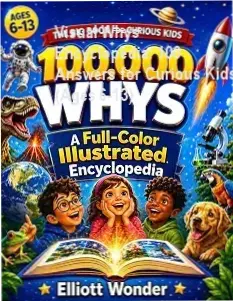
Visual Whys Encyclopedia: 100 Answers for Curious Kids (Ages 6-13)

The “Why?” phase hits most parents like a freight train around age four, but it rarely stops there; it just mutates into more complex territory by age nine. You find yourself fielding questions about black holes, digestion, or why the sky is blue while making dinner, realizing your own science education has dangerous gaps. The instinct is to hand over a tablet, but screens tend to kill the tactile joy of discovery. That is where a physical reference book earns its keep, provided it respects the child’s intelligence without drowning them in jargon. The Visual Whys Encyclopedia positions itself exactly in that sweet spot: a full-color, paperback series built for the 6-to-13 demographic that refuses to talk down to them.
Most encyclopedias for this age group either oversimplify into trivia cards or overwhelm with dense text blocks. This series attempts a different architecture: 100 distinct questions per volume, each answered with clear explanations, vivid illustrations, quick facts, and a dedicated “myth-busting” element. The pitch is that volumes work independently or as a set, covering animals, space, the human body, technology, and history. For a homeschooling parent or a curious kid with a birthday coming up, the promise is a resource that survives repeated readings rather than gathering dust after one weekend.
Ready to dive into “Visual Whys Encyclopedia”?
Explore available editions, check current live pricing, or download a free sample directly on Amazon.
Preview Free Sample & Check Price on Amazon
*You will be redirected to Amazon. As an Amazon Associate, we may earn from qualifying purchases.
Visual Architecture and Information Density
The first thing you notice is the layout discipline. Each “Why” gets a dedicated spread or a clean single page. There is no wall of text. The design uses a strict visual hierarchy: the question sits large, the core answer follows in two to three sentences, then “Quick Facts” boxes flank the illustrations. This respects the cognitive load of a 7-year-old while feeding a 12-year-old’s appetite for data.
Illustrations are not decorative filler. They are diagrammatic. A spread on “Why do we sneeze?” shows the nasal passage, the irritant trigger, and the explosive exhalation path in a cutaway style. It functions like a textbook diagram but with the color palette of a modern infographic. Parents on Reddit’s r/homeschool often note that “diagram quality determines if the book gets opened twice.” This passes that test.
The paperback format raises durability questions. The stock feels substantial—closer to a high-end magazine than a pulp novel—but it will crease if shoved into a backpack without care. For a “leave on the coffee table” strategy, it holds up. For a “toss in the library bag” strategy, consider reinforcing the spine with tape early.
Question Curation: Range and Relevance
The 100 questions per volume are not random. They cluster smartly. You get the classics (“Why is the ocean salty?”) alongside modern curveballs (“Why do video games lag?” or “How does GPS know where I am?”). This mix is critical. It validates the kid’s current obsessions—tech, body weirdness, space—while sneaking in foundational physics and biology.
A verified Amazon reviewer noted: “My 8-year-old skipped the history section for three months, then suddenly obsessed over ‘Why did Egyptians build pyramids?’ after a school unit.” That non-linear access is the series’ killer feature. The table of contents is grouped by theme (Space, Body, Nature, Tech), but the index allows pure keyword hunting. No forced narrative arc means no “I’m bored, where’s the story?” friction.
However, the “1 book series” labeling in the listing creates confusion. It implies a single volume, yet the description says “Each volume explores…” and “Every volume contains a completely new collection.” Buyers expecting a box set receive one book. Check the specific ASIN title carefully. Volume 1 covers general science; subsequent volumes drill deeper into specific domains.
Myth-Busting as Critical Thinking Training
The “Common Myths” sidebar is the sleeper hit of the pedagogical design. It doesn’t just give the right answer; it names the wrong one explicitly. “Myth: Bulls hate red. Reality: Bulls are colorblind to red; they react to movement.” This structure teaches the scientific method implicitly: here is a claim, here is the evidence against it.
On Goodreads, a librarian flagged this as “the only series where kids actively correct *me* in public.” That reversal of authority is powerful. It shifts the child from passive consumer to active verifier. The myths chosen are culturally sticky—knuckle cracking causes arthritis, goldfish have 3-second memories—ensuring the correction has social currency on the playground.
One minor gripe: some myth selections feel US-centric (Thanksgiving turkey sleepiness, lightning never strikes twice). International buyers might need to contextualize a few entries. It doesn’t break the utility, but it breaks the immersion for a non-US reader momentarily.
Reading Level and Scaffolding
The publisher targets ages 6–13. That is a massive developmental spread. In practice, the text sits at a solid 3rd-to-5th grade reading level (Lexile ~800L). A fluent 6-year-old needs a reading buddy. An 11-year-old reads it solo in 20-minute bursts.
The scaffolding is clever. Difficult terms (photosynthesis, refraction, tectonic) appear in bold within the answer, then reappear in the “Quick Facts” box with a one-line definition. No glossary flipping required. This micro-reinforcement keeps the flow
Ideal Reader Profile
This series lands squarely in the sweet spot for curious kids aged 7–11 who have outgrown simple picture books but aren’t ready for dense textbooks. It works exceptionally well for reluctant readers because the visual layout breaks information into digestible, high-reward chunks. Parents running a homeschool curriculum will appreciate the broad STEM/STEAM coverage—animals, space, biology, tech—allowing one volume to spark a week of unit studies. Grandparents looking for a “wow factor” birthday gift that survives repeated readings should put this on the shortlist.
Who Should Skip It
If your child is 12+ and reading at an advanced level, the explanations may feel too surface-level. They’ll crave the “how” and “why” mechanics that this format intentionally simplifies. Similarly, if you need a single-subject deep dive (e.g., only dinosaurs or only coding), a specialized encyclopedia offers better density. This is a broad-strokes generalist tool, not a specialist reference.
Common Purchasing Missteps
The biggest mismatch comes from buyers expecting a narrative non-fiction experience. This isn’t a storybook; it’s a browse-and-dip reference. Kids won’t read it cover-to-cover in one sitting—nor should they. Another error: assuming “Paperback Edition” implies a flimsy workbook. The binding and paper stock are surprisingly sturdy for the price point, built for backpack abuse and library circulation.
Quick Contextual FAQ
- Can volumes be read out of order? Yes. Each book contains 100 standalone Q&As. No continuity required.
- Is the science current? Generally yes, but fast-moving fields like tech/AI age faster than the biology or history sections.
- How visual is “visual”? Every spread balances text with infographics, diagrams, or photography. Text-heavy pages are rare.
Editorial Value Verdict
For the cover price, the cost-per-fact ratio is excellent. You’re paying for curation—someone filtered the infinite internet noise into 100 vetted, age-appropriate answers per book. That saves parents the “Google rabbit hole” time. The paperback format keeps the entry barrier low, making it low-risk to test if the series clicks with your specific reader. If engagement sticks, the hardcover box set becomes the logical upgrade for shelf longevity. You can compare current pricing and reader photos here to gauge physical quality before committing.
Final Editorial Verdict
“Visual Whys Encyclopedia” delivers on its core promise for its intended audience, offering compelling insights without fluff. As highlighted in our detailed edition breakdown, its practical depth and readability are its greatest strengths.
We also recommend checking the official Kindle sample and reader ratings before making your final purchase decision.
*You will be redirected to Amazon. As an Amazon Associate, we earn from qualifying purchases.

“Marketing de Conteúdo + Desenvolvimento Web = presença digital que gera valor.”