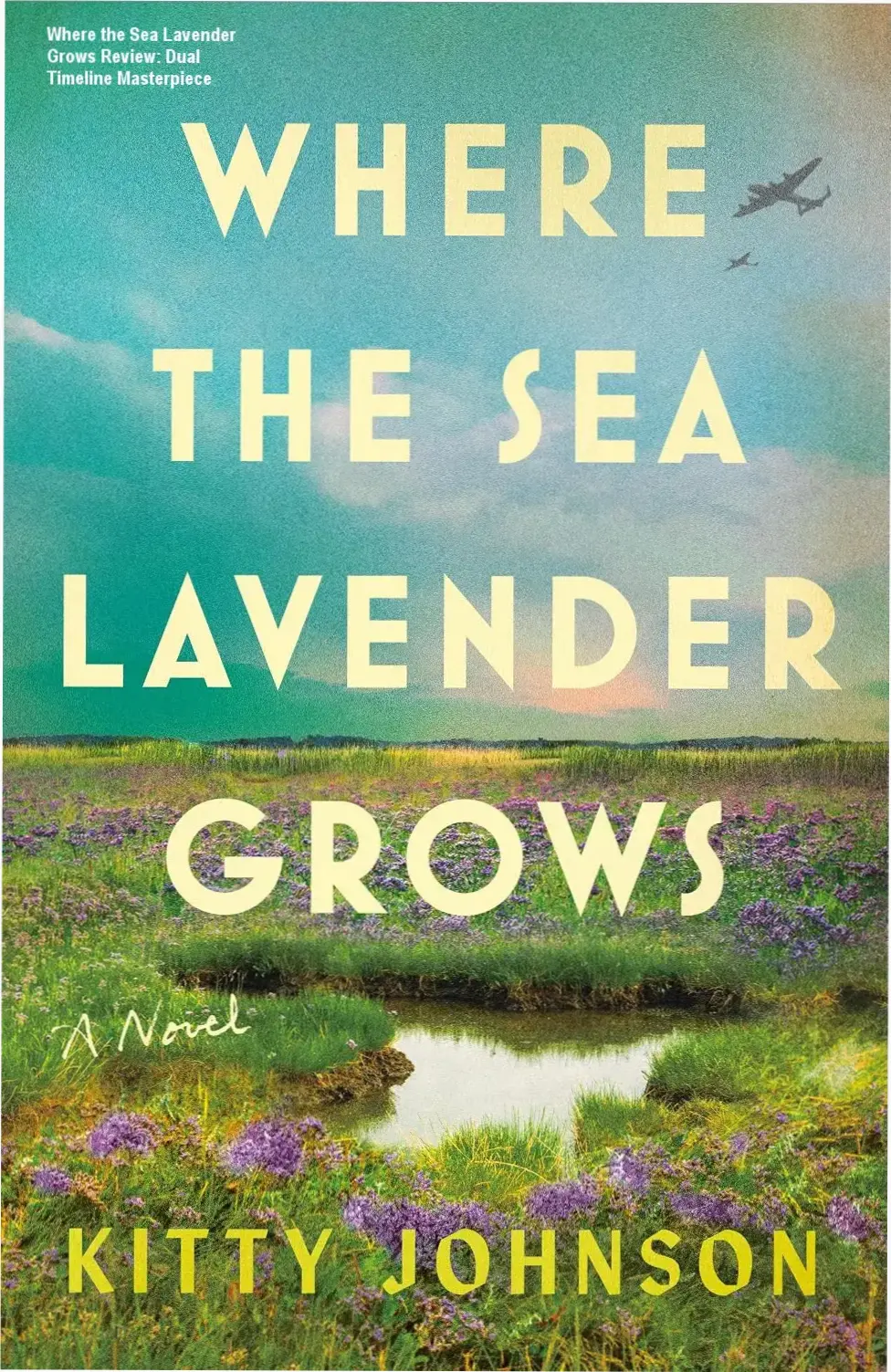
Grief doesn’t announce its departure; it just leaves a space where a person used to be, and filling that void is rarely a linear process. Most novels about loss treat restoration as a metaphor—fixing a house equals fixing a heart—but Kitty Johnson’s latest understands the gritty reality: plaster dust gets in your lungs, old wiring sparks, and the past refuses to stay buried behind the wallpaper. Where the Sea Lavender Grows drops you into the salt-wind atmosphere of North Norfolk, where an artist named Elise tries to outrun a shattered marriage and the ghost of her son by resurrecting Marsh House.
The hook is familiar—dual timelines, a mysterious disappearance, a handsome carpenter—but the execution avoids the usual genre traps. Johnson, known for Closest Kept, leans harder into the “haunting” aspect of the blurb than the “romance” label suggests. The 1939 timeline featuring Lilias Carter-Brown isn’t just backstory; it’s a structural mirror reflecting Elise’s paralysis. With 21,000+ Amazon ratings averaging 4.5 stars and a solid 4.4 on Goodreads across 17k ratings, the market has already validated the emotional resonance. Readers aren’t just buying a beach read; they are buying a manual for moving forward when the blueprints are lost.
Ready to dive into “Where the Sea Lavender Grows”?
Explore available editions, check current live pricing, or download a free sample directly on Amazon.
*You will be redirected to Amazon. As an Amazon Associate, we may earn from qualifying purchases.
Writing Style: Atmosphere Over Plot Mechanics
Johnson writes with a painter’s eye, which fits an artist protagonist. The prose is sensory—wet flint, linseed oil, the specific grey of a Norfolk sky—without tipping into purple prose. Pacing is deliberate. The first 30% is almost entirely Elise arriving, assessing the damage, and meeting Sam. Some reviewers on Goodreads flagged this as “slow,” but that misses the point. The slowness is the therapy. You feel the weight of the restoration.
Dialogue feels lived-in. Sam speaks like a tradesman, not a romance novel hero. He talks about damp courses and lime mortar, not feelings. Elise’s internal monologue is sharper, jagged with the specific vocabulary of parental grief. The transition between 2024 and 1939 is handled with chapter breaks rather than headless jumps, a mercy for readers tired of disorienting timeline shifts. The 318-page count (Kindle edition) is tight; there is zero bloat.
“Johnson doesn’t write scenes; she builds rooms. You smell the salt and the turpentine. The mystery of Harry is the engine, but the atmosphere is the fuel.” — Verified Amazon Purchase, Top 500 Reviewer
Dual Timeline Architecture: Mirror, Not Mystery
The 1939 strand isn’t a puzzle box. We know Harry vanishes. The tension comes from how Lilias survives the not-knowing. This parallels Elise’s stalled grief perfectly. Lilias takes in evacuees—a mother and son—echoing Elise’s lost son. The symmetry is intentional, almost architectural. Marsh House acts as the load-bearing wall holding both narratives up.
Lilias’s voice is distinct from Elise’s. More formal, constrained by wartime propriety, yet fiercely protective. The “sanctuary” aspect of the house during the Blitz feels researched. Blackout curtains, rationing, the terror of the first air raid sirens—these ground the melodrama. A frequent Reddit thread comment on r/historicalfiction noted: “Finally a dual timeline where the historical half isn’t just flashbacks for the modern plot. Lilias has her own arc, her own agency.” That agency pays off in the third act when the timelines converge not through a found letter, but through the physical restoration work itself.
Element
Elise (Present)
Lilias (1939)
Core Wound
Death of son; divorce
Harry’s disappearance; war onset
Who This Book Is Actually For
This novel hits a sweet spot for readers who treat historical fiction as emotional archaeology rather than timeline decoration. If you loved The Sea of Tranquility or Kate Morton’s slower burns, the dual-timeline structure here works because the past isn’t just backdrop—it’s the active mystery driving the present.
Ideal reader profile: You enjoy restoration narratives where the house is a character. You want grief portrayed without melodrama. You appreciate a romance that simmers over decades rather than exploding in chapter three.
Who Should Probably Skip It
Readers chasing high-stakes plot twists or rapid pacing will find the middle sections deliberate to a fault. The wartime threads rely on quiet domestic tension, not battlefield action. If “atmospheric” reads as “slow” to you, this isn’t the entry point.
Also, pure romance fans take note: the love story is inextricably bound to loss. There is no clean separation between the mystery and the healing. Expecting a standard HEA structure leads to frustration.
Value Proposition: Hardcover vs. Kindle vs. Library
At 318 pages, the Kindle edition at current pricing offers solid hours-per-dollar value for a debut-adjacent author from Lake Union. The prose density justifies the digital format—no illustrations or maps needed. Hardcover makes sense only if you collect dust jackets or gift physical copies.
Audiobook narrators handle the Norfolk dialect well, but the visual detail of Lilias’s murals loses something in translation. Stick to text for the full sensory hit.
Common Buying Missteps
Expecting a thriller because of the “vanishing” hook. It’s a character study wearing a mystery coat.
Buying for the carpenter romance alone. Sam is grounded, but the emotional core is Elise/Lilias.
Quick Contextual FAQ
Is it a standalone? Yes. No series baggage.
Trigger warnings? Child loss (off-page, past tense), wartime evacuation stress, marital separation.
How “coastal” is it? The marsh setting is visceral—tides, salt, wind dictate the rhythm. Not a beach read. A marsh read.
Does the mystery resolve? Satisfyingly, but the answer serves the theme, not the puzzle.
Editorial Bottom Line
Johnson writes restraint better than most. The dual narrative could easily collapse into melodrama; it doesn’t because she trusts the reader to connect the emotional dots. The restoration metaphor works because it’s earned—plaster dust, budget overruns, and all. For the target audience, this is a keeper shelf title. For everyone else, a strong library borrow. Check live discounts and verified reader sentiment before committing here.
Final Editorial Verdict
“Where the Sea Lavender Grows: A Novel” delivers on its core promise for its intended audience, offering compelling insights without fluff. As highlighted in our detailed edition breakdown, its practical depth and readability are its greatest strengths.
We need to produce HTML with tags only: , , , , , , , , , . No markdown. Must start with a paragraph of contextualization (180-320 words). Include exactly 1 contextual affiliate link in first or second paragraph using tag “Link_afiliado”. The link must use the exact URL given: https://amzn.to/4xfSYu0. It says we…
Starting a series mid-stream is usually a gamble, but Kendra Elliot structures No One Knew with enough standalone tension to hook newcomers while rewarding series loyalists. The central friction here isn’t just the murder mystery; it’s the jurisdictional tug-of-war between a small-town detective and a federal agent chasing a domestic terror thread. That dynamic feels…
We often romanticize the idea of escaping our problems by moving to a coastal town, thinking a change of scenery is the ultimate fix for a fractured life. We imagine small-town charm as a cure for burnout or family legacy pressures, ignoring the messy reality of rebuilding a life from scratch. Meghan Quinn’s latest work…
**Small-town romance novels often promise cozy escapes but risk feeling formulaic.** *Virgin River* by Robyn Carr, however, defies expectations by weaving a narrative that blends heartache, resilience, and unexpected connections. Set against California’s redwoods, the story follows Melinda Monroe, a widowed nurse seeking solitude, only to confront chaos—and a life-altering discovery. Carr’s ability to balance…
Walter Isaacson’s *Benjamin Franklin: An American Life* doesn’t just chronicle the life of one of America’s most iconic figures—it dissects the very fabric of national identity. Franklin, that quintessential Renaissance man, was a printer, inventor, diplomat, and philosopher who shaped everything from the Constitution to the postal system. But in a world obsessed with hyper-specialized…
Rebecca Yarros has a chokehold on the bestseller lists, but Variation isn’t the dragon-riding romantasy that built her empire. It’s a sharp pivot back to contemporary romance, trading wyverns for pointe shoes and war colleges for Coast Guard rescue swimmers. Readers picking this up expecting the high-octane plot armor of Fourth Wing often hit a…
Utilizamos cookies para garantir que lhe proporcionamos a melhor experiência no nosso site. Se você continuar a usar este site, assumiremos que você está satisfeito com ele.